The first time a puppy or a newly rehomed dog walks past a full-length mirror, the reaction is almost always the same: a hard stare, a low growl or a volley of barks, sometimes a play bow, sometimes a lunge. Then, within days or weeks, nothing. The dog walks past without a glance. That arc, alarm to indifference, is not random. It follows directly from how dogs use their senses to decide whether something is a threat, a friend, or furniture.
What the dog is actually detecting
Dogs build their picture of another animal primarily through smell, then sound, then movement, and finally visual shape. Sight is useful but it ranks below the nose in most situations. When a dog encounters its reflection, it sees a moving shape that matches the size and posture of another dog, ears, tail, body language all present and responding in real time. From a distance, that is enough to trigger the social investigation sequence: stare, vocalise, assess.
The problem for the reflection is what it cannot provide. It has no scent. It makes no independent sound. Every movement it makes is a perfect mirror of the dog's own movement, which means it never behaves the way a real dog behaves. A real dog approaching would carry a smell, would move at a slightly different angle, would blink or sniff or look away. The reflection does none of this. It is visually convincing for about three seconds and socially incoherent after that.
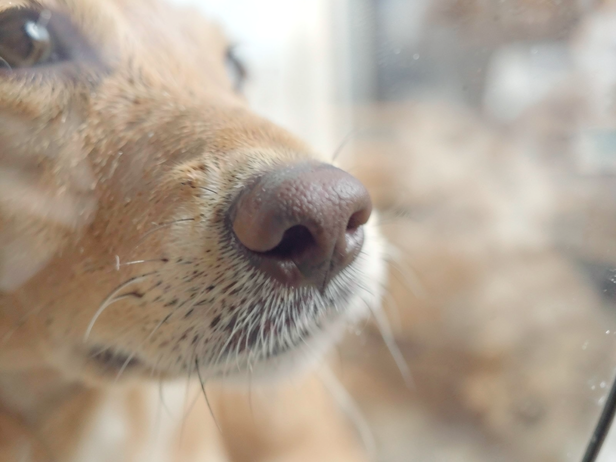
![Nose Meets Glass Reflection]()
Nose Meets Glass Reflection
Image credit : AI
I'm curious about this other dog I see. Why do dogs react to reflections like this?
Why the barking stops
Dogs learn through a process called habituation: repeated exposure to a stimulus that produces no meaningful outcome, no threat, no food, no social contact, causes the response to fade. The reflection barks back but never comes closer, never retreats, never smells like anything. It is, from the dog's point of view, a social interaction that goes nowhere every single time.
Most dogs reach this conclusion within a few encounters. Some take longer, particularly dogs that are generally reactive or that have had limited exposure to mirrors during their early socialisation window. A dog raised in a flat with mirrored wardrobe doors from eight weeks old may never react at all, because the shape-with-no-smell was never novel enough to trigger alarm in the first place.
What the mirror test tells us about dog cognition
The mirror self-recognition test, placing a mark on an animal and watching whether it investigates the mark in its reflection, is used as a rough measure of self-awareness. Dogs reliably fail it. They do not appear to connect the image in the mirror with their own body. This is not a failure of intelligence; it reflects the fact that dogs do not use vision as their primary tool for self-identification. A modified version of the test using scent, presenting a dog with its own urine versus a scent-altered version, suggests dogs do recognise themselves through smell. The mirror is simply the wrong instrument for the species.
This is worth knowing because it reframes what you are watching. The dog barking at the mirror is not confused about reality in some general way. It is applying a perfectly functional detection system to a situation that system was not built to handle. The nose says nothing is there. The eyes say something is. The dog runs the protocol, gets no result, and files the mirror under irrelevant.
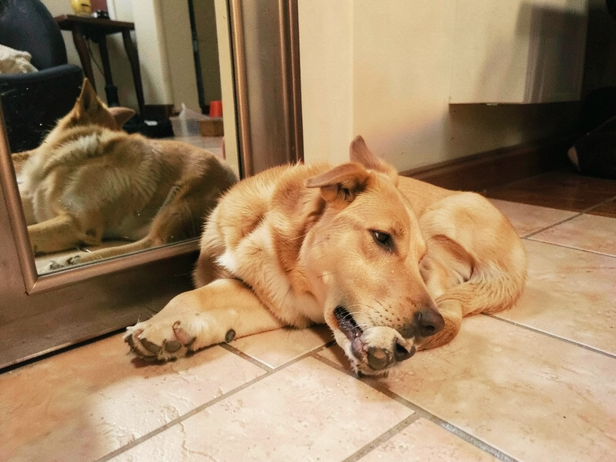
![Dog's quiet reflection moment]()
Dog's quiet reflection moment
Image credit : AI
My dog lies calmly, ignoring its reflection. This quiet moment offers insight into dog mirror behaviour.
When the behaviour is worth a closer look
A dog that reacts to its reflection and then stops is behaving normally. A dog that continues to bark intensely at the mirror after weeks of regular exposure, or that begins reacting to reflections in windows, puddles, and phone screens without any settling, may be showing something other than novelty response. Persistent visual reactivity of this kind, especially if it appears alongside other changes in behaviour, appetite, or sleep, is worth raising with a vet. Some neurological conditions and some forms of anxiety present through heightened reactivity to visual stimuli. The mirror is not the story in those cases; it is a prompt to look at the broader picture.
The dog that glances at the mirror once, barks twice, and never looks again has done exactly what a well-adjusted dog should do: investigated, found nothing actionable, and moved on.