Most cat owners have felt it at least once: the sandpaper drag of a tongue across a hand, a wrist, or the top of a head. It is easy to smile and move on. But the behaviour has a specific social function in cat life, and understanding it tells you something useful about how your cat sees you and whether everything is well.
Allogrooming: what cats do for each other
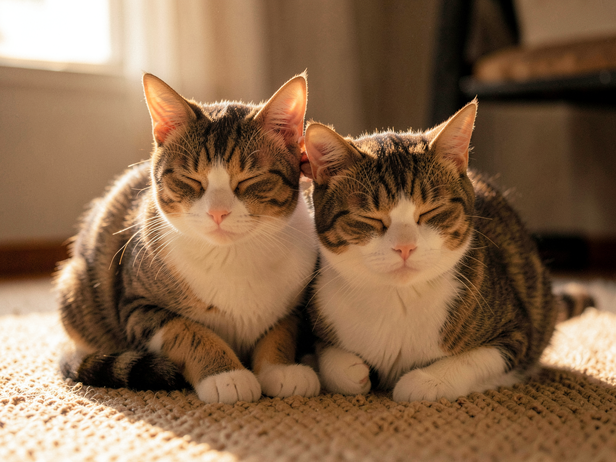
Cats that live together and get along will groom each other, a behaviour called allogrooming. It is not random. Cats focus on the head, ears, and neck, areas the recipient cannot easily reach alone. In multi-cat households, allogrooming is a marker of social trust. Cats do not groom strangers or cats they are in conflict with. When your cat licks you, it is extending the same behaviour to you. You are, in its social map, a member of its group.
![Cats grooming on rug]()
Cats grooming on rug
Image credit : AI
Observing cat grooming behaviour, I see a deep bond. This allogrooming is a sign of trust and affection.
Scent and ownership, the part that is less flattering
Cats have scent glands on their cheeks, paws, and forehead, and they use them to mark things they consider theirs. Licking deposits saliva, which carries scent. When a cat grooms you, it is also layering its scent onto you. This is not possessiveness in a hostile sense, it is the same impulse that makes a cat rub its face on a favourite blanket. You smell like the cat's territory, and that is a comfortable thing for the cat. The two motivations, bonding and scent marking, run together and are not easy to separate. Both are normal.
When it is about the cat's state, not yours
Some cats lick their owners more when they are anxious. Repetitive licking, of you, of objects, or of themselves, can be a displacement behaviour, something the cat does to manage stress it cannot otherwise resolve. If the licking is new, has increased sharply, or comes with other changes like hiding, reduced appetite, or over-grooming patches of fur, it is worth a vet visit. Anxiety in cats has physical causes, pain, hyperthyroidism, and cognitive changes in older cats can all drive repetitive behaviour. A behaviour that looks like affection can occasionally be a signal that something else is going on.
![Cat's Paw and Bowl]()
Cat's Paw and Bowl
Image credit : AI
Exploring the subtle nuances of cat behaviour, like why cats lick their owners, through quiet observation.
What to do if the licking bothers you
The tongue of a cat is covered in backward-facing keratin spines called papillae, designed to pull dead fur out of a coat. On human skin, prolonged licking can become uncomfortable or even cause mild abrasion. Redirecting is straightforward: offer a toy, move your hand gently, or shift position. Do not pull away sharply or punish the behaviour, the cat is doing something socially meaningful from its perspective, and a negative reaction creates confusion without teaching anything. If the licking is frequent enough to be a problem, a qualified cat behaviourist can help you work out whether it reflects a bonding pattern that needs gentle reshaping or an anxiety issue that needs a different approach entirely.