Most cat owners notice it at some point: the bowl is full, the cat reaches in with one paw, drags a piece of food onto the floor, and eats it there. Then does it again. The bowl goes largely untouched while the floor around it gets used as the actual dining surface. It looks fussy, even theatrical. It is neither. The behaviour has a few distinct explanations, and knowing which one fits your cat tells you whether anything needs to change.
Whisker discomfort is the most common reason
![Morning Kibble Scatter]()
Morning Kibble Scatter
Image credit : AI
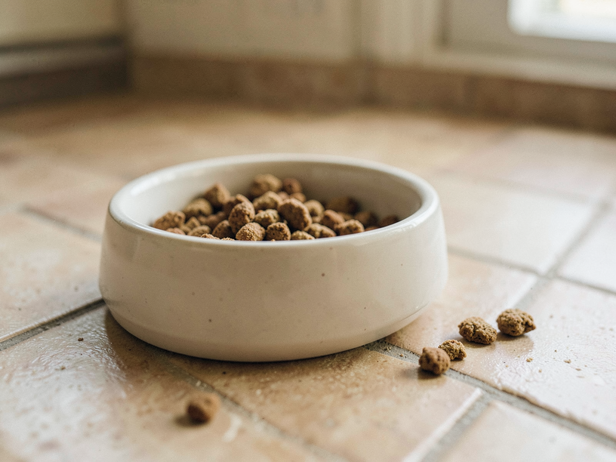
A few pieces of dry kibble scattered on the tiles beside the bowl, hinting at cat eating off the floor behaviour. Soft morning light.
A cat's whiskers are not decorative. They are precision sensory tools, packed with nerve endings that detect pressure and spatial information. When a bowl is too narrow or too deep, the whiskers press against the sides every time the cat lowers its head to eat. This is called whisker fatigue, and while the name sounds dramatic, the experience is genuinely uncomfortable, a constant low-level pressure signal that the cat did not ask for. Pulling food out and onto the floor removes the problem entirely. The cat eats flat on a surface with nothing touching its whiskers. If your cat eats from a small, steep-sided bowl and consistently moves food before eating it, switching to a wide, shallow dish or a flat plate often stops the behaviour within a day or two.
Instinct around prey and peripheral vision
Cats are solitary hunters, and their relationship with food is shaped by that history even in a flat with no other animals around. In the wild, a cat that drops its eyes into a bowl loses its view of the surrounding space. That is a real vulnerability. Eating off the floor while facing outward, or at least with a wider sightline, is a posture that keeps more of the environment visible. Some cats also treat individual pieces of kibble the way they would treat small prey, carrying them a short distance before eating. This is not confusion about what kibble is. It is a behavioural reflex that persists because nothing in domestication has switched it off. The cat is not broken. It is just running old code in a new context.
Competition, real or remembered
![Cat Eating from Floor]()
Cat Eating from Floor
Image credit : AI
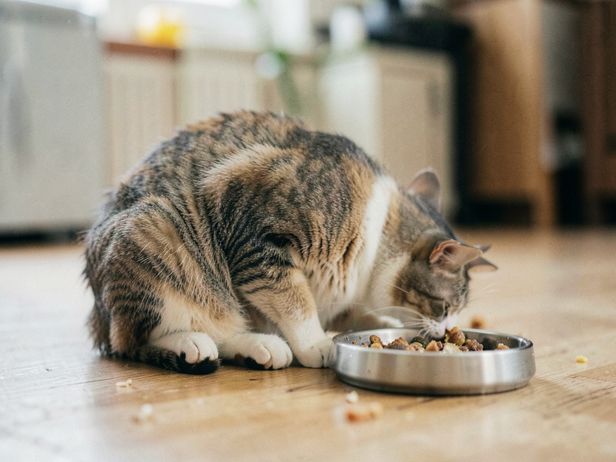
Observing a cat eating off the floor, a behavior sometimes linked to whisker fatigue. This candid shot highlights a common feline feeding habit.
In multi-cat households, food-moving behaviour often intensifies. A cat that grew up having to eat quickly or defend its portion may carry that habit forward even after the competition is gone. Moving food away from the bowl can be a way of creating distance from a perceived rival, even when no rival is present. If you have more than one cat and one of them consistently pulls food away before eating, watch whether the other cats approach that bowl during mealtimes. Sometimes the solution is simply adding a second feeding station in a different room so no cat feels it is eating in contested space.
Texture, temperature, and the bowl itself
Metal bowls can make food cold faster than ceramic or glass, and some cats are particular about food temperature. A cat that pulls wet food onto the floor may be letting it warm slightly before eating, the floor, particularly a tiled one, holds ambient room temperature better than a chilled metal surface. The bowl's surface can also affect taste perception in cats through smell: metal can carry an odour that the food itself does not, and some cats are sensitive to it. If the bowl-pulling happens mainly with wet food and mainly in cooler conditions, temperature or material is worth testing. Try a wide ceramic plate warmed briefly with warm water before serving.
When to look more carefully
Bowl-pulling on its own, in a cat that is otherwise eating well and behaving normally, is not a health concern. It becomes worth a vet conversation if the behaviour appears suddenly in a cat that never did it before, especially alongside other changes: eating less overall, dropping food while chewing, pawing at the mouth, or showing any reluctance to chew on one side. These can point to dental pain, a sore tooth makes eating from a bowl at an angle uncomfortable, and moving food to the floor lets the cat control the angle of approach. A cat that starts doing this after years of normal eating deserves a dental check rather than a new bowl. The floor-eating habit itself is not the problem in that case; it is the cat's solution to one.