A cat that eats grass is not confused about being a carnivore. The behaviour shows up in indoor cats, outdoor cats, kittens, and elderly cats, which means it is almost certainly serving a purpose rather than reflecting a deficiency in how the cat is kept.
The leading explanations for grass eating
Cats lack the enzyme needed to digest plant matter efficiently, so grass almost always comes back up. For a long time this was read as the point: the cat eats grass to trigger vomiting and clear something from its stomach, whether a hairball, an undigested bone fragment, or intestinal parasites. A 2019 survey-based study published in Ecology and Evolution found that grass eating was more common in younger, healthier cats and was not consistently followed by vomiting, which weakened the purge-trigger theory as the sole explanation.
A more current view treats it as an instinctive behaviour inherited from wild felid ancestors. Wild cats consume prey whole, and the indigestible plant material in a prey animal's gut may have helped move intestinal parasites through and out. The cat doing it today is not dealing with a gut full of mouse grass, but the drive remains. A second possibility is that grass provides folic acid, a B vitamin present in plant juice that supports cell production. Cats cannot manufacture it in sufficient quantities on their own, and a cat on a nutritionally complete commercial diet is unlikely to be deficient, but the drive to seek it out may predate commercial feeding by millennia.
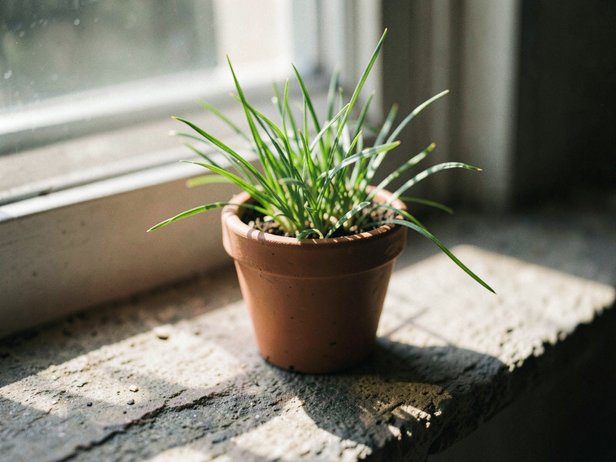
![Morning Cat Grass Still Life]()
Morning Cat Grass Still Life
Image credit : AI
I'm enjoying this fresh cat grass, a natural treat for indoor cats. It's important to know why cats eat grass.
Why houseplants attract them
Texture and movement are the most likely draws. Long, narrow leaves move in air currents the way grass blades do, and cats are wired to investigate moving things. Cats that live entirely indoors with no access to a garden patch are more likely to turn to houseplants, which suggests the behaviour is partly an outlet for something the environment is not otherwise providing.
Stress and boredom amplify it. A cat in a flat with limited enrichment, few climbing options, and long stretches of solitude may chew plants more than a cat with more to do. This does not mean the behaviour is purely psychological, it may be both instinctive and stress-modulated at the same time.
When the plant is the problem, not the chewing
The behaviour itself is not dangerous. The plant often is. Several common houseplants are toxic to cats, and the toxicity ranges from mild gastrointestinal upset to acute kidney failure. Lilies are the most serious: all parts of true lilies (Lilium species) and daylilies (Hemerocallis species) are highly toxic to cats, and even a small amount can cause kidney failure. Dieffenbachia, pothos, philodendron, and peace lily cause oral irritation and vomiting. Sago palm causes liver failure. Oleander affects the heart.
If a cat has chewed or ingested any part of a plant and you are not certain the plant is safe, treat it as a potential poisoning and reach a vet immediately, do not wait for symptoms to develop. Kidney damage from lily ingestion, for example, may not show obvious signs until it is advanced.
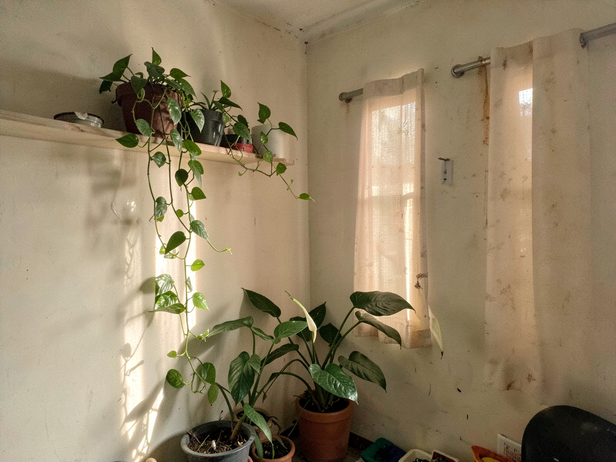
![Indian flat, sunlit plants]()
Indian flat, sunlit plants
Image credit : AI
Peace lily and pothos thrive in the warm light. Wondering why cats eat grass?
What to do if the chewing is frequent
Offering cat grass, wheat grass, oat grass, or barley grass grown specifically for cats, gives the cat a safe outlet and often reduces interest in houseplants. It is widely available in Indian pet stores and easy to grow on a balcony or windowsill. Place it near the spots the cat already gravitates toward.
Move toxic plants out of reach entirely. For a cat that climbs, out of reach means a room the cat cannot access, not a high shelf. Enrichment helps: puzzle feeders, window perches, rotating toys, and regular play sessions address the boredom component without eliminating the underlying drive, which is not something an owner can or should try to suppress.
Frequent grass eating combined with repeated vomiting that is not producing a hairball, or any vomiting that contains blood or is accompanied by lethargy or a loss of appetite, is a reason to see a vet. Occasional vomiting after eating grass in an otherwise healthy, active cat is normal; daily vomiting is not.