Dogs communicate in gestures most owners learn to overlook. A flick of the tongue across the lips, a quick swipe over the nose, these happen in seconds and vanish before you think to question them. They are easy to read as post-meal reflex or idle habit. Often, they are neither.
What calming signals actually are
Ethologist Turid Rugaas, who spent years studying dog communication, identified a set of behaviours she called calming signals: small, deliberate movements dogs use to reduce tension in themselves or in the animals and people around them. Lip licking and nose licking are among the most common. The dog is not licking because there is food nearby. It is performing a self-soothing action, the way a person might exhale slowly before a difficult conversation.
These signals evolved as social tools. In a group, a dog that licks its lips is often signalling non-threat, telling another dog, or a person, that it is not looking for conflict. In a flat in Bengaluru or Noida, the same signal shows up when a dog is asked to do something it finds uncomfortable, when a stranger leans over it, or when the household energy is tense.
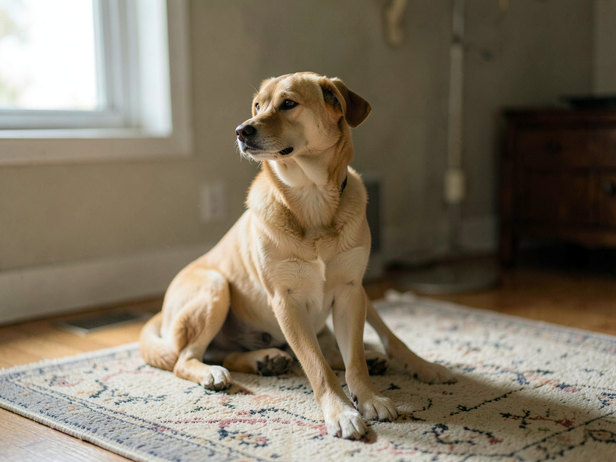
![Relaxed Dog on Rug]()
Relaxed Dog on Rug
Image credit : AI
Observing subtle dog stress signals, like lip licking, can offer insight into their well-being.
The situations that bring them out
Watch when the licking happens, not just that it happens. A dog that licks its nose the moment you raise your voice is responding to tone. One that licks its lips every time a child runs toward it is reading the approach as pressure. One that does it repeatedly during a training session may be telling you the session has gone on too long, or that the ask is too hard, or that the reward is not worth the stress.
Common triggers in a home setting: direct eye contact held for more than a few seconds, a hand reaching over the head rather than under the chin, being hugged or restrained, loud or sudden sounds, unfamiliar visitors, and the owner's own anxiety, dogs read body language and cortisol cues with unsettling accuracy. A dog in a car that licks its lips continuously is likely experiencing motion-related nausea or stress, sometimes both at once.
The signal is often paired with others: a yawn outside a tired context, a sudden sniff at the ground, turning the head away, a slow blink, or a body that goes slightly stiff. One signal alone is a data point. Several together are a clear sentence.
When the cause is physical, not emotional
Lip licking that is frequent, intense, or happens without any obvious social trigger can point to something the body is doing rather than something the dog is feeling. Nausea is the most common physical cause, a dog with an unsettled stomach licks its lips in much the same way a person swallows repeatedly before they are sick. This can come from motion sickness, a dietary change, eating grass, or early gastric discomfort.
Excessive drooling from a dental problem, a mouth ulcer, or a foreign object caught between the teeth can also drive repeated lip licking. A dog that licks its lips obsessively at night, paces, and seems unable to settle may be experiencing acid reflux, a real and underdiagnosed condition in dogs that causes discomfort when the stomach is empty.
Skin irritation around the muzzle, a contact allergy, or a small wound the dog is trying to reach can produce the same motion. If the licking is focused and the dog returns to the same spot repeatedly, look at the skin rather than the stress calendar.
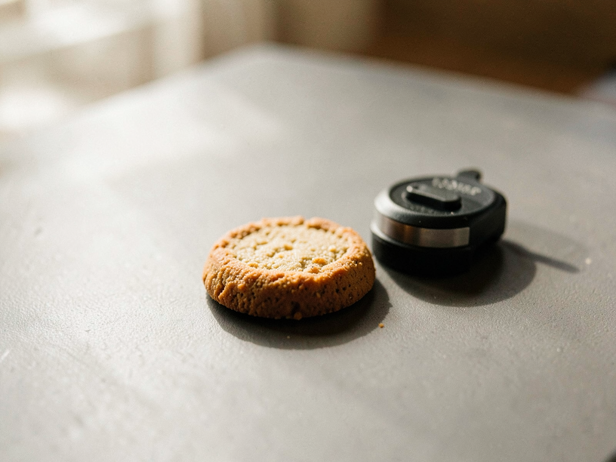
![Dog Treat and Clicker]()
Dog Treat and Clicker
Image credit : AI
A simple setup for training, perhaps to address dog lip licking stress. Focus on positive reinforcement.
How to respond when you notice it
The most useful thing is to pause and reduce pressure. If the licking appears during a training session, stop the exercise and give the dog a moment without any ask. If it appears when someone approaches, ask that person to slow down, turn sideways, and let the dog come to them rather than the other way around. If it appears when you hold eye contact, look away. These are not concessions to bad behaviour, they are accurate responses to what the dog is communicating.
Reward-based training helps here in two ways: it reduces the ambient stress of learning, and it gives you a clearer read on threshold. A dog working happily does not lick its lips between repetitions. When it starts, you have found the edge of its comfort zone. That edge is useful information, not a problem.
Do not punish the signal. A dog that is corrected for showing discomfort does not become less uncomfortable, it learns to suppress the signal. That makes the dog harder to read, not easier to live with. If lip licking is frequent, tied to specific situations, and paired with other stress signals such as panting, pacing, or refusing food, a qualified trainer or veterinary behaviourist can help you identify the pattern and address what is driving it. If the licking is intense, focused on one area, happens mostly at night or on an empty stomach, or is accompanied by gulping, retching, or grass eating, have a vet check the dog's gut and mouth before assuming it is behavioural.