A cat arriving at your feet with a toy mouse clamped in her mouth, meowing loudly, is not performing for your amusement. She is doing something her nervous system is built for, and the meowing is the part that makes it a communication, not just a delivery.
The hunting sequence that never quite finishes
Cats are solitary hunters, but they share one behaviour with social predators: the impulse to bring a catch back to a safe place. In wild and feral cats, a mother brings prey to her kittens, first dead, then alive, to teach them what to do with it. That sequence is wired in. A domestic cat who has never caught a real mouse still runs the full motor programme: stalk, pounce, carry, deliver. The toy is standing in for the prey. Your living room is the den. You are the recipient.
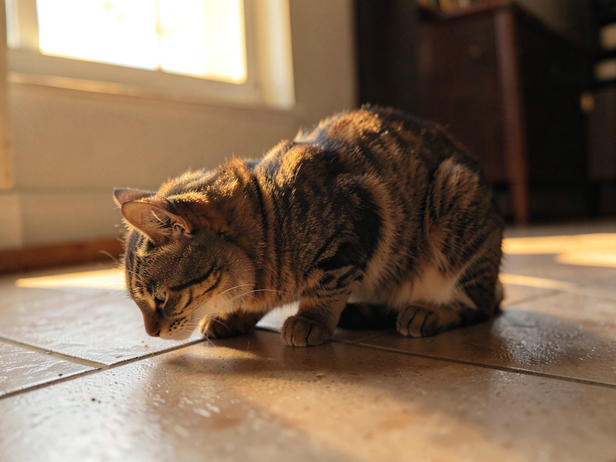
![Cat hunting in golden light]()
Cat hunting in golden light
Image credit : AI
I'm in a hunting posture, eyes fixed forward, paws tucked. This is my cat behavior explained.
Why the meowing is the key part
The vocalisation changes what this means. Cats do not meow at each other as adults in the wild, that sound is reserved almost entirely for communicating with humans, and it develops in individual cats based on what gets a response. When a cat carries a toy and meows, she is combining a physical action with a call directed at you. She is not just depositing something. She is presenting it and waiting to see what you do. Some cats repeat the circuit, pick up, carry, meow, drop, pick up again, until you respond. The meow is the ask. What she is asking varies by cat, but the most common readings are: play with me now, acknowledge what I brought, or simply, I am doing something and I want you involved.
What your response teaches her
If you pick up the toy and throw it, she learns this is how the game starts. If you speak to her and then ignore the toy, she learns the sound gets attention regardless. If you consistently do nothing, many cats stop the behaviour over time, not because they are sulking, but because a behaviour that produces no result tends to drop out. Cats are efficient. The delivery-and-meow routine is most persistent in cats whose owners have, at some point, engaged with it. You trained this, probably without meaning to, and that is not a problem. It is just how cats learn what works with the specific humans they live with.
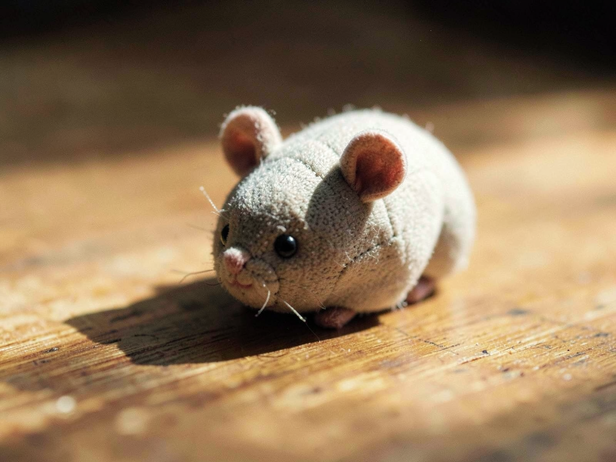
![Soft Toy Mouse in Light]()
Soft Toy Mouse in Light
Image credit : AI
This little fabric mouse awaits its next adventure, a silent observer of morning light. Why does my cat bring me toys?
When it points to something other than play
A cat who suddenly begins this behaviour after years of not doing it, or who does it repeatedly through the night and seems unsettled rather than playful, is worth paying attention to. Increased vocalisation paired with restlessness can be a sign of hyperthyroidism, pain, or cognitive changes in older cats, conditions where a vet visit is the right next step, not a training adjustment. The behaviour itself is normal; the change in pattern is what matters. If the toy deliveries are accompanied by a cat who also seems to be eating more, losing weight, or vocalising in other contexts without clear cause, have her checked.