A resting cat with a flicking tail is not a contradiction. The tail is moving precisely because the rest of the cat has decided not to, and that gap between stillness and motion is where the message lives.
The tail as a readout of arousal
Cats regulate their social signals through body parts they can move independently of each other. Ears, pupils, whiskers, and tail all carry information simultaneously, which is why a cat can look relaxed in posture and still be broadcasting something with its tail. The slow, single flick, one deliberate sweep from side to side, typically signals low-level alertness. The cat has noticed something: a sound from another room, a bird outside the window, the faint smell of food. It has not decided to act, but it has registered the input. The tail flick is the outward sign of that internal processing.
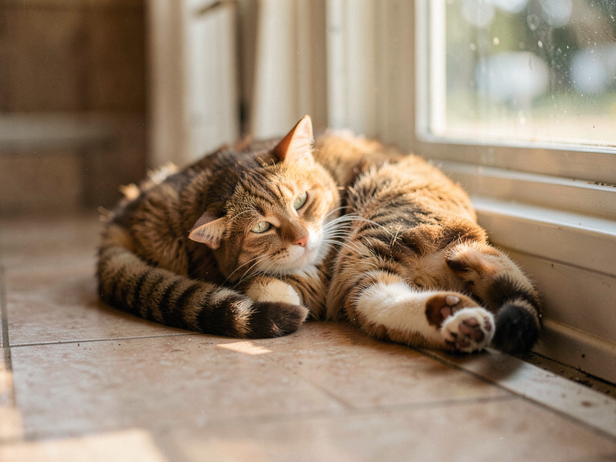
![Golden Hour Cat Nap]()
Golden Hour Cat Nap
Image credit : AI
Observing the subtle language of a cat's tail flicking meaning while it rests in the golden light.
When the flick means leave me alone
A faster, sharper tail movement, especially one that tightens into a thump against the floor, is a different signal entirely. Cats use this pattern when stimulation is building past what they want. A hand stroking the same spot repeatedly, a child hovering too close, a noise that keeps repeating: the tail escalates from a slow sweep to a quick flick to a full thrash as the cat moves through tolerance toward irritation. Many owners read a resting cat as a cat that wants company. The tail is often saying the opposite. When the flick sharpens and the ears begin to rotate backward, the cat is asking for space before it asks with its claws.
Dreams, twitches, and the sleeping brain
A cat in light sleep will sometimes flick its tail with no external trigger at all. Cats cycle through sleep stages much as other mammals do, and during the phase equivalent to REM sleep, small involuntary movements appear, a paw twitch, a whisker flutter, a single tail beat. These are not signals. They are the motor system briefly leaking activity from a dreaming brain. The distinction is easy to read: a dreaming flick happens in a cat that is genuinely still, eyes closed, breathing slow, with no obvious stimulus in the room. A signal flick happens in a cat whose eyes are open or half-open, tracking something.
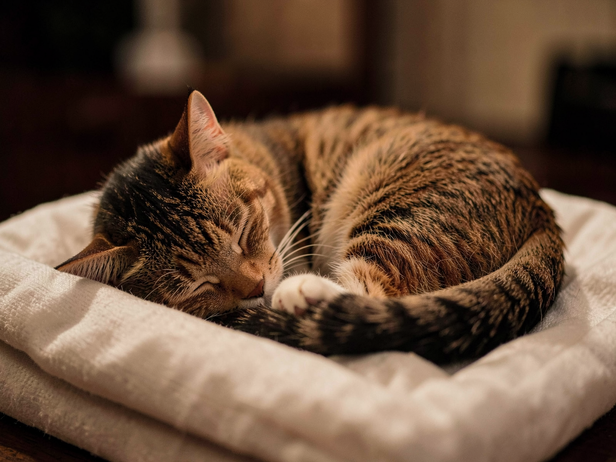
![Sleeping Cat's Gentle Twitch]()
Sleeping Cat's Gentle Twitch
Image credit : AI
My cat's tail twitching while lying down hints at dreams. Observing cat body language at rest is fascinating.
When the tail tells you something is wrong
A cat that flicks or lashes its tail persistently while resting, with no apparent stimulus and without the context of sleep, is worth watching. Chronic tail movement in a resting cat can point to pain, particularly lower-back or tail-base discomfort, which cats do not always announce loudly. Some neurological conditions also produce involuntary tail movement. If the flicking is new, happens in a cat that was previously still at rest, comes with changes in appetite, posture, or litter habits, or if the cat reacts when the tail or lower back is touched, that is a reason to have a vet look at it, not later in the week, but soon.