A dog's paw landing on you is one of those moments that feels loaded with meaning. The instinct is to read it as affection, and sometimes that is exactly right. But the paw is also how a dog asks for food, signals discomfort, seeks reassurance, and occasionally asserts that your attention has wandered somewhere it shouldn't have. The gesture looks identical each time. The reason behind it rarely is.
The attention bid, the most common reason
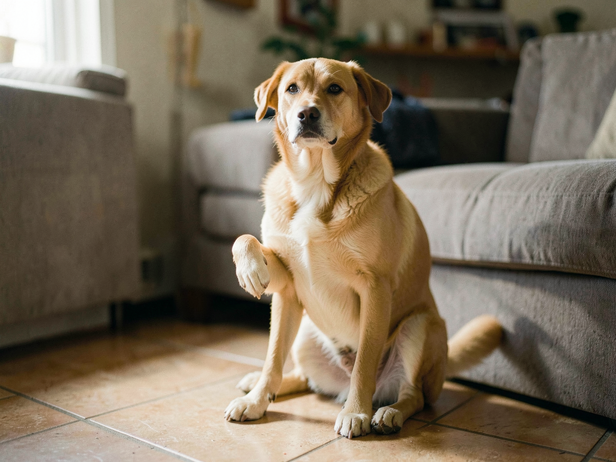
Most of the time, a paw on your knee or arm is a straightforward request. Your dog wants something: your eyes, your hand, your presence. Dogs learn quickly that physical contact produces a response from humans. The first time a puppy pawed at someone and got a scratch behind the ear, that connection was reinforced. Every repetition since has strengthened it. This is operant conditioning at its most basic, a behaviour that works gets repeated.
The attention bid usually comes with an upright, relaxed body, ears in a neutral position, and sometimes a nudge from the nose as well. The dog is not distressed. It is just reminding you it exists.
![Dog's Gentle Paw Gesture]()
Dog's Gentle Paw Gesture
Image credit : AI
My dog's pawing behaviour often means they're seeking attention. I wonder why does my dog put its paw on me?
When the paw signals something more than a request
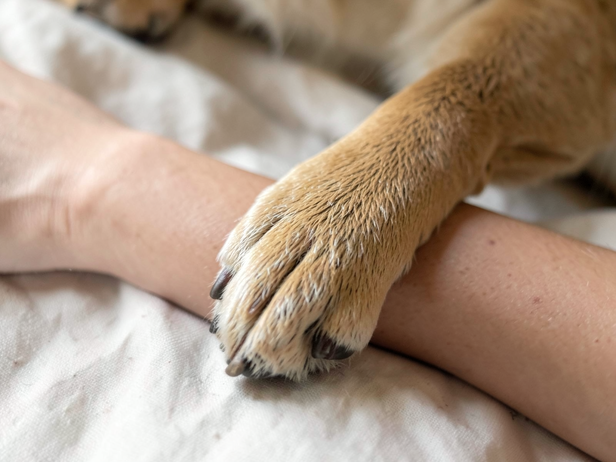
A paw placed slowly and held, rather than tapped and lifted, often carries a different weight. Dogs use sustained contact to seek comfort when something has unsettled them: a loud sound outside, a change in the flat, a stranger who came and went. The body language here is softer. The dog may lean in, lower its head slightly, or make sustained eye contact. It is not asking you to do something. It is asking you to stay close.
This is also the gesture you will see from a dog that is in low-level pain or not feeling well. The difference is in what accompanies it: reduced appetite, reluctance to move, a dull coat, or a change in how the dog holds itself. A paw placed on you by a dog that otherwise seems off is worth paying attention to rather than simply reciprocating.
Empathy, or something that looks like it
Dogs are unusually good at reading human emotional states, research on dog cognition consistently shows they respond differently to a person who is crying or distressed than to someone who is calm. When a dog places a paw on you while you are upset, it is responding to real cues: your posture, your voice, your breathing. Whether this constitutes empathy in the way humans experience it is a genuinely open question in animal behaviour science. What is not open is that the response is real and consistent, not coincidental.
Some dogs do this reliably whenever a family member is distressed. Others do it rarely. Individual variation is wide, and a dog that does not reach out this way is not less attuned, it may simply express the same attentiveness differently.
![Gentle Paw Connection]()
Gentle Paw Connection
Image credit : AI
My dog seeks attention with its paw, a gentle touch that speaks volumes.
When the paw is about the dog, not you
Not every paw placement is warm in its intent. A dog that paws insistently, repeatedly, and escalates when ignored is often a dog whose attention-seeking has been reinforced past the point of a gentle request. This is not a character flaw, it is a training outcome. If pawing has always worked, the dog has no reason to try anything else.
Occasionally, persistent pawing at a specific part of your body, your hand, your face, can be a dog that has learned to redirect its own anxiety through contact with you. This is worth distinguishing from simple demand behaviour, because the response is different: demand behaviour responds well to consistent non-reinforcement, while anxiety-driven contact needs the underlying anxiety addressed rather than just the behaviour suppressed.
If the pawing is frequent, escalating, or accompanied by other signs of stress, panting without heat, yawning repeatedly, pacing, an inability to settle, a qualified trainer or veterinary behaviourist is the right next step. Pain should also be ruled out by a vet if the change in behaviour is recent and unexplained.
How to respond without accidentally teaching the wrong thing
The response that feels most natural, immediately reaching back, making eye contact, speaking to the dog, is also the response that most reliably reinforces the behaviour. That is not necessarily a problem if the behaviour is one you want. A dog that paws gently to say it needs a walk or wants company is communicating clearly and usefully.
The issue arises when the pawing becomes the dog's only tool, deployed at any volume and any hour. If that is where things have gone, the fix is not to punish the paw, that teaches the dog that contact produces a bad outcome, which is the opposite of what the relationship needs. Instead, reward the dog for an incompatible behaviour: sitting calmly, lying down, making eye contact without touching. The paw does not disappear; it becomes one option among several rather than the only one the dog knows.
The paw placed on your knee during a quiet evening, the slow lean that follows, the dog that finds you when something in the flat has shifted, these are not random. They are a vocabulary built across years of living with people, shaped by what worked and what the dog needed. Reading it accurately is less about translating a single gesture and more about watching the whole animal.