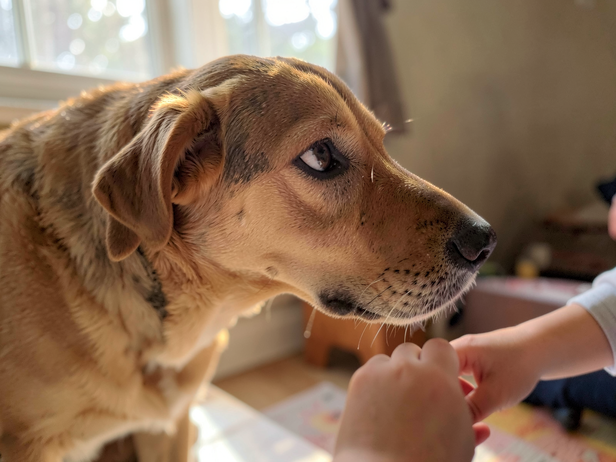
A dog staring sideways, head turned slightly away but eyes locked on something, a pale crescent of white visible at the corner, this is whale eye, and it is one of the most reliable stress signals in canine body language. Most owners see it and feel vaguely uneasy without knowing why. The unease is correct. The dog is telling you something is wrong.
What whale eye actually is
Dogs have a third eyelid and, in most positions, very little visible sclera, the white part of the eye. When a dog turns its head away from something but keeps its gaze fixed on it, the eye rotates in the socket and exposes that white crescent. The shape is why behaviourists named it whale eye: it resembles the way a whale's eye sits wide and pale on the side of its head.
The posture itself is the tell. The dog wants to look away, turning the head is a calming signal, a way of communicating non-threat, but it cannot stop watching whatever is worrying it. The result is a split body: head averted, eyes still tracking. That conflict between the impulse to disengage and the need to monitor is exactly what whale eye communicates.
![Dog's Subtle Warning]()
Dog's Subtle Warning
Image credit : AI
I'm showing whale eye, a subtle stress signal, as the hand gets too close. My body remains still, but my eyes tell the story.
What it usually means in a home setting
Whale eye shows up in a narrow set of situations, and they share a common thread: the dog feels cornered, pressured, or uncertain about what is about to happen.
Common triggers in an Indian flat include a child approaching too fast and leaning over the dog's face, someone reaching toward the dog's food bowl or a chew while the dog is eating, a stranger entering the home and moving directly toward the dog before it has had time to assess them, being held still for grooming or nail clipping, and being hugged, a gesture humans read as affection but dogs often experience as restraint.
The behaviour is not aggression. It is the warning before aggression becomes possible. A dog showing whale eye is asking for space and distance. If that request is ignored, the next signal in the sequence is usually a hard stare, a lip curl, a low growl, or a snap. Whale eye is the dog trying to avoid that outcome.
Other causes worth ruling out
Not every visible sclera is a stress signal. Anatomy matters: flat-faced breeds like Pugs and Shih Tzus have naturally prominent eyes, and some sclera may be visible at rest without any emotional content behind it. Some dogs show more white when they are simply relaxed and watching something interesting, though the body posture in those cases is loose and soft rather than stiff.
Pain can also produce a whale-eye-adjacent look. A dog with neck pain, a sore ear, or eye discomfort may hold its head at an odd angle and show white at the eye's edge. If whale eye appears suddenly in a dog that is not in a stressful situation, and especially if it comes with reluctance to move the head normally, that warrants a vet visit rather than a behavioural assessment.
Cognitive changes in older dogs can also alter how they hold their gaze and respond to their environment. A senior dog showing new and unexplained stress signals, including whale eye in situations that never bothered them before, is worth discussing with a vet to rule out pain, vision loss, or cognitive dysfunction syndrome.
![Watchful Dog's Quiet Moment]()
Watchful Dog's Quiet Moment
Image credit : AI
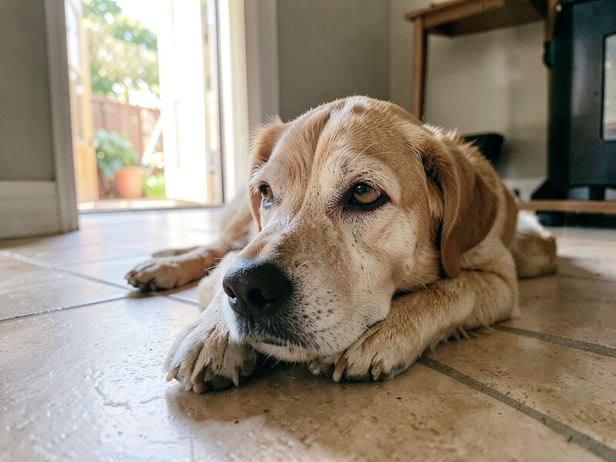
This dog's gaze, showing the whites of its eyes, indicates a relaxed but watchful state. Observing its surroundings.
What to do when you see it
The immediate response is to reduce pressure. If a child is leaning over the dog, calmly redirect the child. If you are mid-grooming, pause and give the dog a moment to settle. If someone is approaching the dog's resource, step back. The goal is to show the dog that the thing it was worried about has stopped.
Do not punish the signal. A dog scolded for showing whale eye does not stop feeling stressed, it stops warning you before it acts. The warning is useful. It is the dog communicating through a system it has. Suppressing it removes your ability to read what the dog is experiencing.
Over time, if whale eye appears frequently in situations that should feel ordinary, during routine handling, around familiar people, near its own food bowl, that pattern points toward a dog that is chronically stressed or has learned that certain interactions go badly for it. A qualified trainer or veterinary behaviourist is the right next step, not more correction.
Reading it alongside the rest of the body
Whale eye is one signal in a conversation. A dog showing it with a stiff body, weight shifted back, tail tucked or held low, and ears pinned is communicating significant distress. The same eye shape on a dog with a loose body, soft ears, and a gently wagging tail is far less urgent, it may simply be tracking something with mild interest.
The habit worth building is reading the whole dog rather than any single feature. Whale eye flags that something is worth paying attention to. The rest of the body tells you how urgent that something is. Dogs that live with owners who read these signals accurately and respond to them tend to need fewer dramatic warnings over time, because the early ones were enough.