Most dog owners have seen it: the poop is done, and then comes the kicking, hind legs scraping backward across the grass, sometimes with real enthusiasm, often flinging dirt and debris well past the original spot. It looks like covering up, but that is not what is happening. The behaviour is called ground-scratching or ground-scraping, and it is one of the more deliberate acts of communication a dog makes on a walk.
It is about scent, not tidiness
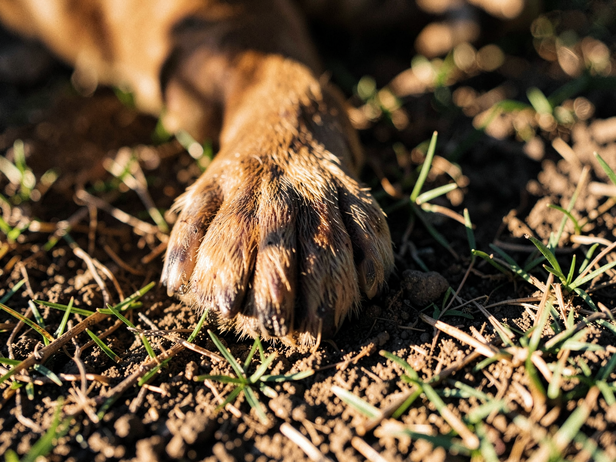
Dogs have scent glands tucked between the pads of their paws, interdigital glands that deposit a chemical signature every time the foot makes contact with a surface. When a dog kicks after defecating, he is not scattering the faeces. He is layering a second message on top of the first. The faeces already carry information from the anal glands: identity, health status, reproductive state. The ground-scratch adds a visual mark, the disturbed earth, and a pheromone trail from the paw glands that sits at nose height for any dog walking past. It is a compound signal: here, and it was me.
![Paw on Earth's Embrace]()
Paw on Earth's Embrace
Image credit : AI
My paw rests on the earth, a moment of quiet observation. Understanding dog behaviour after defecating is fascinating.
Why the kicking often goes wide of the actual spot
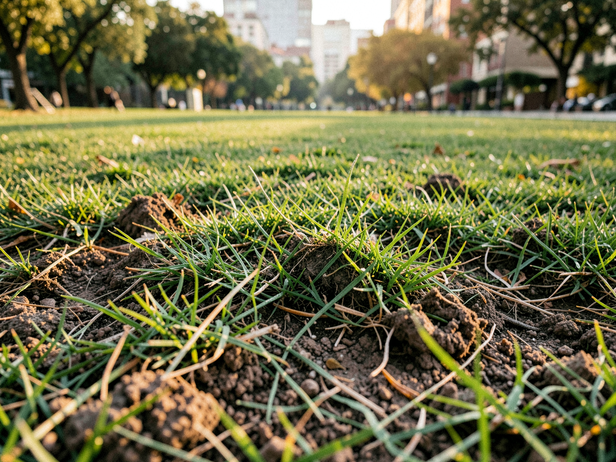
This is where owners get confused. The dog kicks several feet away from where he actually defecated, sometimes in a completely different direction. That is not poor aim. The visual disturbance, the torn-up patch of grass or dirt, is itself part of the message. It is designed to be seen from a distance, to draw another dog in toward the scent. The faeces and the scratch mark work together, but they do not need to overlap to do their job.
Which dogs do it more, and why
Not every dog kicks with the same frequency or force. Intact males tend to do it most often and most vigorously, because scent-marking is closely tied to reproductive signalling. Intact females do it too, particularly around oestrus. Neutered dogs still do it, the behaviour is not purely hormonal, but often with less intensity. Confident, socially assertive dogs tend to kick more than anxious or submissive ones. A dog who has never done it is not missing something; a dog who does it constantly is simply a thorough communicator. Neither is a problem.
![Torn Park Grass, Golden Light]()
Torn Park Grass, Golden Light
Image credit : AI
I observe the aftermath of dog behaviour after defecating, a common sight in urban parks.
When it is worth paying attention to
Ground-scratching after defecating is normal behaviour across the species. It does not need to be stopped or corrected. The moments worth noticing are different ones: if your dog is straining during defecation, producing very little, crying, or showing blood in the stool, those are signs that need a vet's attention, the kicking itself is not the issue. Equally, if a dog who has never kicked suddenly starts doing it compulsively and out of context, a veterinary check is reasonable, since obsessive repetitive behaviours in dogs can sometimes have an underlying physical or neurological cause. But a dog kicking enthusiastically after a normal bowel movement on his morning walk is doing exactly what dogs do.