If you have ever sat quietly near your budgie's cage in the evening and heard a faint, repetitive clicking or grinding sound coming from inside, you were almost certainly hearing a healthy bird settling down for sleep. The sound is the upper and lower mandibles moving against each other in a slow, deliberate rhythm, and in budgies it is one of the clearest signs that the bird feels safe.
What is actually happening in the beak
A budgie's beak is made of keratin, the same protein that forms human fingernails, and it grows continuously throughout the bird's life. The two halves, the upper mandible and the lower, need to stay in alignment and at the right length to let the bird crack seeds, preen, and climb. Beak grinding at rest appears to be partly mechanical: the bird works the surfaces against each other in a way that keeps the edges slightly worn and smooth. It is not the same motion as the hard, purposeful grinding a bird does when it is working on a cuttlebone or a mineral block. Bedtime grinding is softer, slower, and often accompanied by the bird fluffing its feathers and shifting its weight onto one foot, both postures that lower heat loss and signal genuine relaxation.
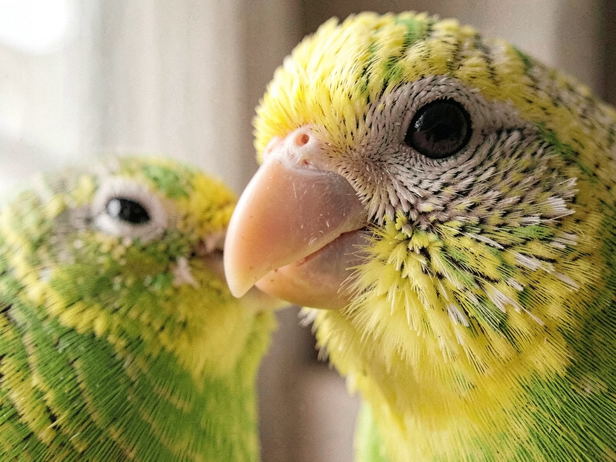
![Budgie's Beak Close-Up]()
Budgie's Beak Close-Up
Image credit : AI
I notice the budgie's beak grinding, a common behavior before sleep.
Why contentment and not pain
The association between beak grinding and a relaxed state is well established among avian vets and experienced keepers. A bird in discomfort tends to show the opposite cluster of signals: sitting low on the perch, feathers held tight rather than fluffed, eyes open and watchful, and often a reluctance to eat. Pain-related beak behaviour usually looks like repeated, forceful rubbing of the beak against a perch or the cage bars, not the quiet grinding that happens as the eyes begin to close. The bedtime grind typically starts within a few minutes of the bird choosing its sleeping perch, and it fades as the bird drifts off. Some budgies do it every night; others only occasionally. Both are normal.
What the flock context tells us
Budgies are flock birds. In the wild, a bird that grinds its beak is broadcasting to nearby flock members that it has assessed the environment as safe and is going offline for the night. In a home with a single budgie, the behaviour still happens, the bird is not performing for an audience, it is expressing a physiological state. In a home with two or more budgies, you will sometimes hear them start grinding in sequence, one bird following another the way a yawn travels through a group of people. This is not imitation in any complex sense; it is more likely that one bird's relaxed posture and sounds lower the arousal level of the birds nearby, and the same settling response follows.
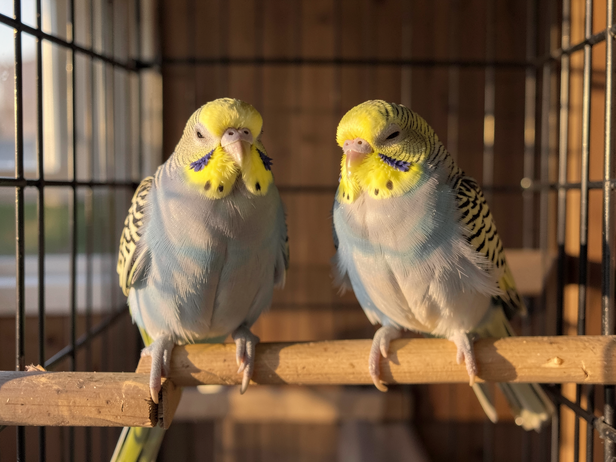
![Relaxed Budgies Evening Perch]()
Relaxed Budgies Evening Perch
Image credit : AI
These budgies are exhibiting relaxed fluffed postures, a common sign of contentment. One budgie's eyes are half-closed, perhaps preparing for rest.
When grinding is worth a closer look
The distinction that matters is between grinding that happens at rest, in a relaxed bird, as part of a clear wind-down, and grinding or clicking that happens throughout the day, in a bird that also looks unwell. A budgie that grinds or clicks its beak repeatedly during active hours, especially if it is also sitting fluffed during the day, losing weight, passing loose droppings, or showing any discharge from the nostrils or eyes, needs a vet to look at its beak alignment, its crop, and its overall condition. Beak overgrowth, a misaligned bite, or an underlying illness can all produce abnormal beak sounds. The bedtime grind is self-limiting and quiet; anything that persists, sounds wet or laboured, or comes with other signs of illness is a different matter entirely.
The grinding you hear as your budgie tucks in for the night is the bird's equivalent of a long exhale at the end of a day it found acceptable. It does not need to be fixed, encouraged, or worried about, it just needs to be recognised for what it is.