Dogs are not quiet animals, even when they are doing nothing. The sigh that follows a long walk, the theatrical groan as they collapse onto a cool floor, the soft grumble before sleep, owners notice these sounds and wonder whether they signal contentment, discomfort, or something in between. The answer depends on context, and most of the time it is reassuring.
The sigh: what it usually means
A dog's sigh is a long, slow exhale through the nose or slightly open mouth. It happens most often when a dog has just settled after a period of activity or excitement, a walk, a play session, a car ride. Physiologically, it is a respiratory reset. After sustained exertion or mild stress, the breathing pattern shifts; a deep exhale helps regulate it back toward a resting rate. In that sense, a sigh after exercise is roughly analogous to the breath a person lets out when they finally sit down.
Context matters. A sigh that comes at the end of an active period, followed by relaxed body posture, loose limbs, soft eyes, a weight dropped comfortably onto the floor, is a sign of a dog unwinding. A sigh that comes repeatedly during rest, with no obvious preceding activity, can sometimes accompany low-level frustration or boredom, particularly in high-drive breeds that have not had enough mental or physical engagement that day. Watch what the sigh follows, not just the sigh itself.
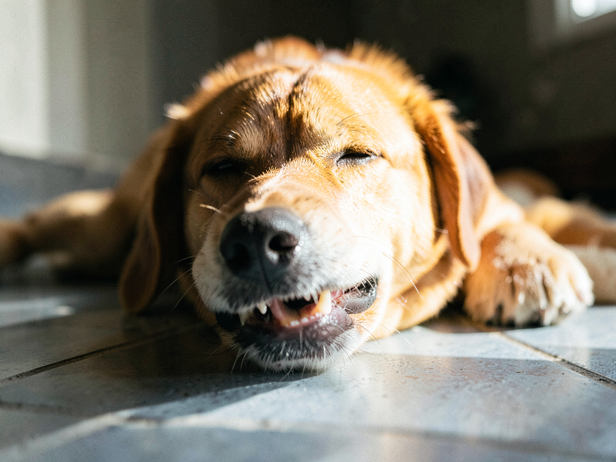
![Dog's Quiet Moment]()
Dog's Quiet Moment
Image credit : AI
I'm resting, perhaps a dog sighing when lying down. The light is warm, the floor cool.
The groan: joint comfort versus habit
The groan is louder and usually comes at the moment of lying down, as the dog lowers its body to the floor. For many dogs, especially larger breeds and those past middle age, this is straightforwardly mechanical. The musculoskeletal load of lowering a heavy body shifts through the joints, and the vocalisation accompanies the effort. It is the same sound a person makes sitting down heavily after a long day.
In younger, physically healthy dogs, the groan is often learned behaviour. Dogs are quick to notice that certain sounds produce a response, a glance, a word, a pat, and a groan that once happened by accident can become a small performance repeated because it works. If your dog groans dramatically, holds the sound, and then watches you, that is usually what is happening.
Where the groan becomes worth noting is when it is new, when it is accompanied by a reluctance to lie down, when the dog circles repeatedly before settling, or when getting back up produces the same sound. These patterns can indicate joint discomfort, hip dysplasia, elbow issues, early arthritis, particularly in breeds predisposed to them. A groan on its own proves nothing; a groan alongside changed movement patterns is a reason to have the dog examined.
The grumble: contentment, not complaint
The low, rumbling grumble that some dogs produce while settling is almost always a contentment sound. It sits at the lower end of the vocalisation range, is typically brief, and accompanies the final adjustment before sleep, a shift of weight, a rearrangement of limbs. Dogs that grumble this way tend to do it consistently, in the same situations, with relaxed body language throughout.
It is worth distinguishing this from a growl, which carries tension in the body: stiffened posture, a fixed gaze, weight shifted forward. A grumble at rest has none of that. The dog is comfortable and settling in. Some dogs are simply more vocal than others in this register, and the grumble is part of their individual signature.
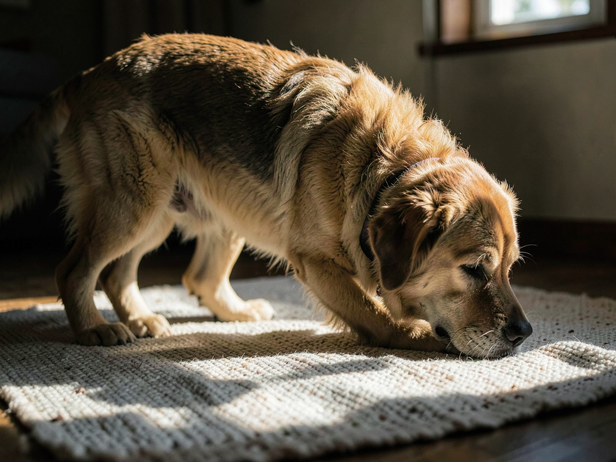
![Elderly dog settles down]()
Elderly dog settles down
Image credit : AI
My old friend sighs as he settles down, a familiar sound of comfort and rest.
When the sounds point to something else
Pain changes the pattern. A dog that vocalises when lying down and also shows any of the following warrants a vet visit: difficulty rising from rest, stiffness after sleep that takes several minutes to ease, a reluctance to use stairs or jump onto surfaces it previously managed easily, licking at a joint, or a change in how it distributes weight while standing. Abdominal discomfort can also produce vocalisations at rest, a dog that groans, looks at its flank, or cannot settle into a comfortable position may be dealing with digestive pain rather than joint or muscle issues.
Cognitive changes in older dogs can also alter vocalisation patterns. A dog that begins sighing or grumbling more than usual, particularly at night or in situations that previously caused no reaction, may be experiencing the disorientation associated with canine cognitive dysfunction. This is a conversation for a vet, not a training problem.
The sounds dogs make when they lie down are mostly ordinary, a physical reset after effort, a habit that got reinforced, a contented rumble before sleep. What changes their meaning is what surrounds them: the dog's age, its movement, its posture, and whether the pattern is new. A dog that has always groaned when it flops down is telling you very little. A dog that has started doing it is worth watching.