Gouramis explore their environment the way a person might run a hand along a wall in a dark room, slowly, deliberately, touching before committing. The long, trailing fins you see hanging from the front of the fish are not decorative. They are labyrinth fish antennae, and the tapping you watch is active sensing.
Those fins are not fins in the usual sense
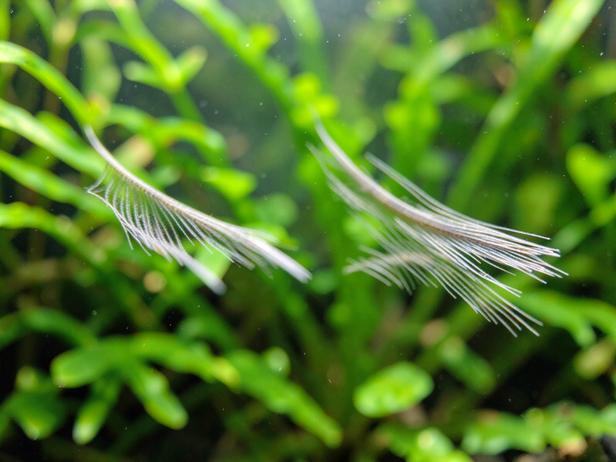
![Gourami Feelers in Focus]()
Gourami Feelers in Focus
Image credit : AI
Extended gourami feeler fins, a sensory organ, explore their aquatic environment. Macro detail highlights texture and light.
Most fish use their pectoral fins for steering and balance. Gouramis belong to a group called anabantoids, which includes bettas and paradise fish, and in this group the pelvic fins have evolved into something different. The front pair has become two long, filamentous feelers, often called feeler fins or ventral feelers, that extend well beyond the body and end in a soft tip packed with touch receptors and chemoreceptors.
This means the fins detect both physical contact and dissolved chemicals in the water. When a gourami extends a feeler toward a plant stem, it is simultaneously feeling the texture and sampling whatever is clinging to that surface, biofilm, microorganisms, the chemical trace of another fish. The two streams of information arrive together.
Why gouramis need this kind of sensing
Gouramis evolved in slow-moving, densely vegetated water across South and Southeast Asia, rivers choked with roots, rice paddies, swamps where visibility drops to a few centimetres and turbidity shifts with the rain. In that environment, sight has limits. A fish that can reach out and touch before moving forward has a real advantage over one relying only on eyes.
The feelers also help gouramis locate food. Wild gouramis eat insects, larvae, and small invertebrates hiding in vegetation. Tapping through a tangle of plants is a more reliable search strategy than scanning visually in murky water. In a home aquarium, the same behaviour shows up when a gourami works along the glass or probes a corner, it is hunting, or at least checking whether hunting is worth it.
What the tapping actually looks like, and what it means
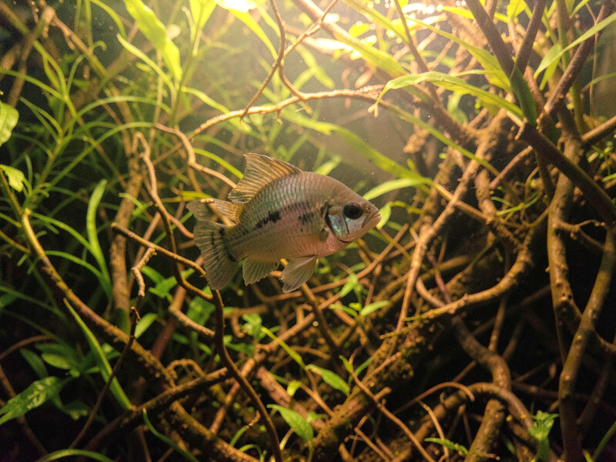
![Gourami in Lush Aquarium]()
Gourami in Lush Aquarium
Image credit : AI
A gourami's ventral feelers trail as it hovers in a planted aquarium, showcasing its unique sensory organ behaviour.
A gourami at rest will often let its feelers hang loose and drift. When it is actively exploring, the feelers stiffen slightly and extend forward, and the fish moves toward whatever it is investigating with a deliberate, almost cautious posture. Contact with a plant or the glass is brief, a tap, sometimes a slow drag, and then the fish either moves on or returns for another pass.
Contact with another fish is different. Two gouramis feeling each other out with their feelers is normal social behaviour, a way of assessing a tankmate without committing to a chase or a display. A gourami that repeatedly taps a smaller fish and then follows it is doing something else: it has identified the smaller fish as prey or as a target for aggression, and the tapping is the prelude. Watch what comes next before deciding whether to intervene.
A gourami that has stopped using its feelers, keeping them folded against the body, not extending them even when a new object is introduced, is worth watching. Feeler withdrawal can follow fin damage, but it also shows up when a fish is unwell or stressed. It is not a diagnosis, but it is a change in normal behaviour, and changes in normal behaviour are the earliest signal that something in the tank needs attention.
The labyrinth organ connection
Gouramis are labyrinth fish, meaning they have a supplementary breathing organ that lets them take oxygen directly from the air. This is the adaptation that allowed their ancestors to survive in oxygen-depleted water. The feeler fins are a separate adaptation to the same environment, but the two evolved together, and both reflect the same ecological pressure: life in water where the usual rules do not quite apply.
Understanding one helps you understand the other. A gourami that rises to the surface regularly is not sick, it is breathing normally for its kind. A gourami that taps everything in the tank is not restless or confused, it is reading the room in the only way evolution gave it. Both behaviours look odd if you are used to fish that breathe only through gills and navigate only by sight. They make complete sense once you know what kind of water this fish came from.
The feelers are also fragile. They regrow if damaged, but in a tank with fin-nipping species, tiger barbs, serpae tetras, some cichlids, a gourami will lose them repeatedly, which is both stressful for the fish and a sign the tankmates are wrong for it. A gourami without feelers is not blind, but it is navigating with one sense missing in an environment where that sense matters.