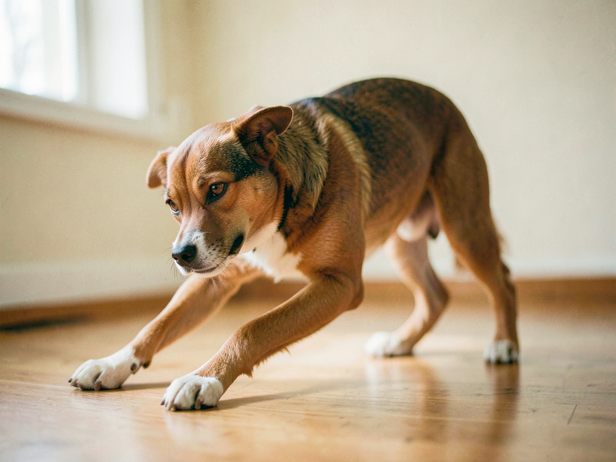
The move is unmistakable: you open the door, your dog looks up, and before the tail even gets going, the front legs shoot forward, the chest drops toward the floor, and the back end stays high. It lasts two seconds, maybe three. Then it is over and the dog is on you. Most owners assume it is a yawn-stretch, a coincidence of timing. It is not.
It has a name: the greeting stretch
![Dog's Playful Greeting Bow]()
Dog's Playful Greeting Bow
Image credit : AI
A dog's enthusiastic play bow, a clear sign of excitement and invitation to interact. Understanding canine body language is key.
Behaviourists and trainers call this specific posture a greeting stretch or a greeting bow. It is distinct from the morning stretch a dog does after sleep, which is slower, bilateral, and done in private. The greeting stretch happens in direct response to a social trigger, your arrival, and it is aimed at you. The dog is not working out a kink. It is communicating.
What the posture is actually signalling
The play bow, chest low, hindquarters up, is one of the most studied signals in canine communication. When it appears at the start of play, it functions as an invitation and a kind of social contract: what follows is play, not aggression. The greeting stretch uses the same skeletal shape. Directed at a returning owner, it reads as a combination of excitement and deference. The dog is saying it is glad you are back and that it is not a threat. Both at once, in a single two-second posture. Dogs use the same bow mid-play to reset the tone after a rough patch, a signal that the interaction is still friendly. At the door, it serves the same reset function: reestablishing the relationship after the gap of your absence.
Why some dogs do it and others don't
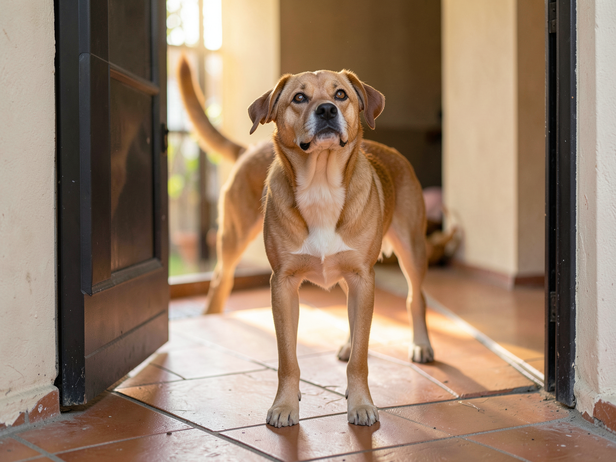
![Calm Dog Awaits Return]()
Calm Dog Awaits Return
Image credit : AI
A dog's calm posture, tail low, hints at anticipation. Understanding canine body language, like this relaxed stance, reveals their gentle nature.
Not every dog greets this way, and the difference is not about affection. Individual dogs vary in how physically expressive they are, just as people do. A dog that greets with a full-body wriggle and no bow is not less bonded to you. A dog that greets with stillness and a single tail wag is not indifferent. The greeting stretch tends to show up more in dogs that are generally communicative with their bodies, breeds with loose, expressive musculature, or dogs that have learned their signals get a response. If your dog does it and you have always responded warmly, you have reinforced it. That is not manipulation; it is a dog learning that a particular signal works.
When the stretch is something else
Context matters. A greeting stretch at the door, lasting two to three seconds and followed by normal behaviour, is a social signal. A stretch that happens repeatedly throughout the day, especially after eating, or one accompanied by a distended belly, restlessness, or an inability to settle, is a different thing entirely. Repeated stretching after meals in a large or deep-chested dog, a Labrador, a German Shepherd, a Great Dane, can be an early sign of gastric discomfort. If the stretching is frequent, paired with unproductive retching, a tight or bloated abdomen, or obvious distress, stop reading and call a vet. That is not a greeting. That is pain.
What to do when your dog greets you this way
Nothing needs fixing. The greeting stretch is a healthy, affiliative signal. If you want to reinforce it, meet it calmly, a quiet hello, a hand offered at nose level, a moment before the full reunion. Dogs that are met with immediate high-pitched excitement sometimes escalate past the bow into jumping or mouthing; the bow itself is the more composed version of the greeting, and it is worth meeting in kind. The stretch is your dog at its most socially fluent: using a precise, readable signal to tell you exactly how it feels about you walking back in. Most of what dogs do is harder to read than this. This one is clear.