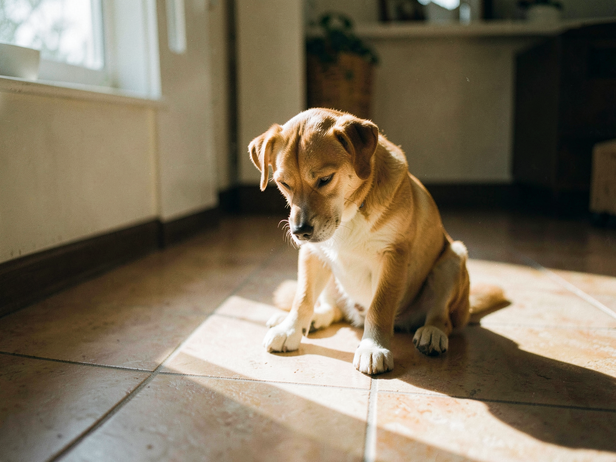
Walk into a room where something has gone wrong and your dog is already doing it: head low, ears back, eyes wide and soft, maybe a slow tail wag aimed at the floor. Every owner reads this the same way. The dog knows. Except the research says that is probably not what is happening.
The study that started the conversation
Alexandra Horowitz, a cognitive scientist who studies dog behaviour, ran a now widely cited experiment in 2009. Owners were told, sometimes truthfully and sometimes not, that their dog had eaten a forbidden treat before they entered the room. The dogs who received a scolding showed the guilty look regardless of whether they had actually eaten anything. Dogs who had eaten the treat but whose owners greeted them warmly showed almost none of it. The look tracked the owner's tone and body language, not the dog's prior behaviour. What Horowitz concluded was that the guilty look is a response to the owner's demeanour in the present moment, not a signal of remembered wrongdoing.
![Quiet Dog, Soft Light]()
Quiet Dog, Soft Light
Image credit : AI
This dog's posture might suggest a guilty look, a common canine behavior when feeling scolded.
What the look is actually made of
The postures that read as guilt, lowered head, averted gaze, flattened ears, a tucked tail, slow body movements, are the same postures dogs use in appeasement and conflict avoidance. Ethologists call this a submissive display. Dogs are acutely good at reading human emotional states: your posture when you walk in, the tension in your voice, the way you pause before speaking. When those cues signal displeasure, the dog responds with behaviour that historically reduces conflict. It is a social survival tool, not a moral reckoning. The dog is not confessing. It is de-escalating.
The memory question
A separate but related issue is how dogs handle time. Dogs have associative memory, they link a behaviour to its consequence very well when the two happen close together, which is why reward-based training works. But the window for that association is short, measured in seconds to a few minutes for most everyday learning contexts, not the hours between chewing a cushion in the afternoon and your return in the evening. By the time you come home, the dog cannot connect your reaction now to what it did then. It can only connect your reaction to the immediate situation: you, your mood, the room. This is why scolding a dog for something it did hours ago achieves nothing except teaching it that your homecomings are sometimes frightening.
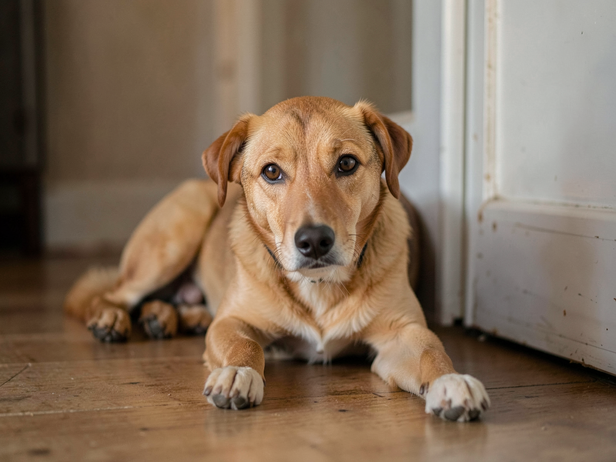
![Dog's Quiet Evening Wait]()
Dog's Quiet Evening Wait
Image credit : AI
My dog waits patiently, exhibiting submissive behaviour near the door. Early evening light bathes the scene.
Why this matters for how you respond
If the guilty look is appeasement rather than remorse, punishing it is punishing the wrong thing. The dog offered a social signal asking for calm. Responding with anger confirms that the situation is dangerous, which increases anxiety without reducing the unwanted behaviour. The behaviour that caused the problem, the chewing, the bin-raiding, the indoor accident, needs to be addressed through management and training, not through a confrontation the dog cannot connect to its cause. Put the bin out of reach. Crate-train if the dog is destructive when alone. Reward the behaviours you want. The guilty look, whenever it appears, is a signal about the dog's emotional state in front of you right now. That is all it is, and that is actually worth paying attention to.