The puffed tail is one of the most visible things a cat's body does, and it happens without the cat choosing it. The hairs along the tail and often the spine stand on end through a reflex called piloerection, driven by the sympathetic nervous system, the same system that raises goosebumps in humans under stress or cold. The cat is not performing. Its nervous system has taken over, and the tail is the most obvious sign.
The two states that cause it
Piloerection in cats happens in two distinct emotional states, and they look similar from across the room but mean different things up close.
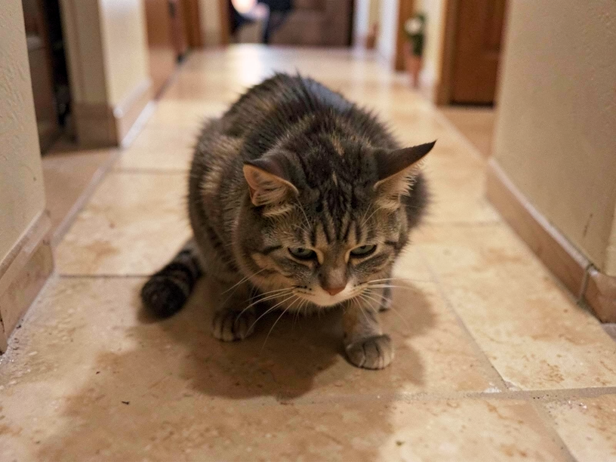
The first is fear. A frightened cat puffs its tail to appear larger than it is, a reflex inherited from wild ancestors for whom looking bigger could end a confrontation before it started. The body posture that comes with fear-puffing is usually low and tucked: the cat crouches, flattens its ears sideways or back, and tries to make itself smaller while the tail contradicts that by expanding. It wants to escape, not fight. If there is a route out, it will take it.
The second is arousal or aggression. A cat in an offensive or highly stimulated state also puffs, but the body language is the opposite of fearful. It stands tall, weight forward, tail raised and bushed. This cat is not looking for an exit. It is deciding whether to advance. This posture appears during territorial disputes with another cat, during redirected aggression after a window encounter with a bird, or when play has crossed into genuine overstimulation.
The distinction matters because the correct response to a frightened cat and an aroused cat is different. A frightened cat needs space and quiet. An aroused cat needs distance and time before any interaction.
![Frightened Cat's Puffed Tail]()
Frightened Cat's Puffed Tail
Image credit : AI
I observed this cat's puffed tail, a clear sign of fear. Understanding cat body language, like piloerection, is fascinating.
What the rest of the body is saying
The tail never tells the whole story on its own. Read it alongside three other signals.
Ear position separates fear from aggression reliably. Ears flattened sideways and low mean fear. Ears rotated back and flattened tight to the skull mean aggression or extreme arousal. Ears forward, even with a puffed tail, usually mean the cat is startled but not yet committed to either response.
Pupil size adds context. Dilated pupils in a puffed cat point to high arousal, fear, or pain. Constricted pupils with a puffed tail and a forward-leaning posture point to offensive aggression. Neither is a diagnosis, but the combination narrows what you are dealing with.
Vocalisation is the third signal. A hissing, spitting cat with a puffed tail is communicating a clear boundary. A silent cat with a puffed tail and wide eyes is processing something it has not yet decided how to respond to. Give the silent cat more time before approaching.
Common triggers in a flat
Most puffed-tail episodes in a home environment trace back to a handful of situations. A sudden loud noise, a stranger entering the space, an unfamiliar smell on a bag or piece of clothing, or an unexpected encounter between two cats in the household. Kittens puff more readily than adult cats because their threat-assessment is less calibrated; a plastic bag rustling can produce a full bottle-brush tail in a four-month-old.
Redirected aggression is worth understanding separately. A cat watching a street dog or a bird through a window can become so aroused that it turns and attacks the nearest thing, including a person or another cat in the home. The puffed tail in this moment is a warning the owner often misses because the trigger is not obvious. If a cat has been watching something through glass and then puffs and turns, do not touch it. Leave the room and give it fifteen to thirty minutes.
Pain is a less obvious trigger. A cat that puffs its tail when you touch a specific part of its body, or that has started puffing in situations where it previously did not, may be reacting to discomfort rather than a perceived threat. This pattern, especially if it appears alongside changes in appetite, movement, or litter box behaviour, is worth a vet visit.
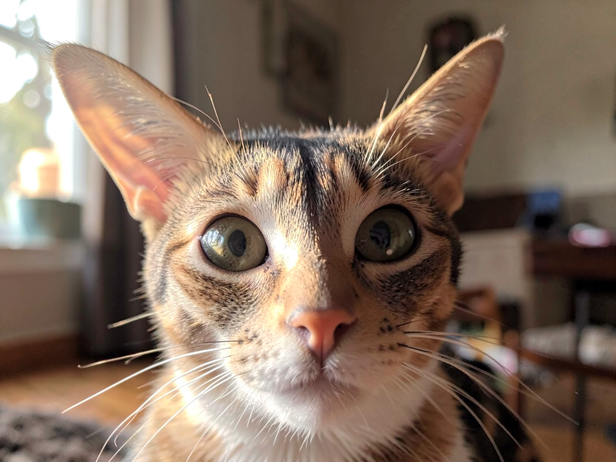
![Cat's Intense Gaze]()
Cat's Intense Gaze
Image credit : AI
My cat's wide eyes and ears back suggest a moment of intense focus. Understanding cat body language is fascinating.
What to do and what not to do
The instinct to comfort a puffed cat is understandable and usually counterproductive. Reaching toward a frightened or aroused cat compresses the space it is trying to protect and raises the chance of a scratch or bite.
The better response is to reduce the trigger if you can identify it, create an exit route, and wait. Most piloerection episodes resolve in minutes once the perceived threat is gone. The nervous system that switched on will switch off on its own.
For cats that puff frequently in response to other cats in the household, the underlying issue is usually territory, resource competition, or an introduction that happened too quickly. Separate feeding stations, multiple litter boxes, and vertical space help more than any single intervention.
A cat that puffs its tail when touched in a specific spot, that puffs without a visible trigger, or whose puffing episodes have increased in frequency is showing you something worth investigating with a vet rather than managing at home.
The puffed tail is not a personality quirk or a sign of a difficult cat. It is the nervous system doing exactly what it was built to do. Reading what accompanies it tells you far more than the tail alone.