A fish that looks vivid under the tank light and pale an hour after lights-out is not sick. It is doing exactly what fish do when the light goes, and understanding why makes it far easier to tell the difference between a healthy night-time fade and something worth worrying about.
Colour in fish is not paint, it's a live system
Fish get their colour from specialised cells called chromatophores, packed with pigment granules. The two most relevant here are melanophores, which carry dark pigment, and xanthophores and erythrophores, which carry yellow and red. These cells don't just sit there. They respond to signals, light, hormones, stress, temperature, by dispersing pigment outward to make the colour vivid, or pulling it back toward the cell's centre to make the fish look pale. The colour you see at any moment is the result of where those granules currently are, not a fixed property of the fish.
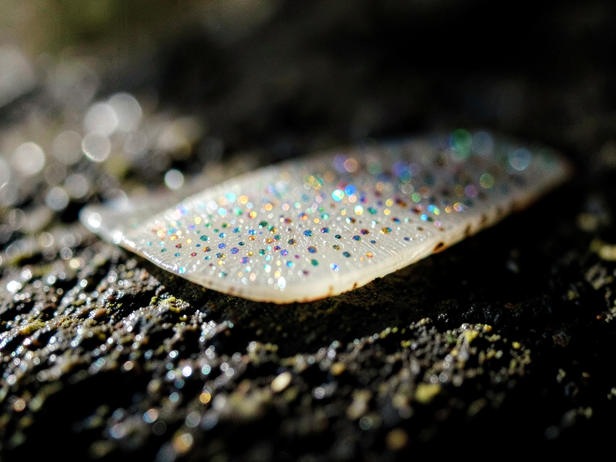
![Iridescent Fish Scale Detail]()
Iridescent Fish Scale Detail
Image credit : AI
I observe the chromatophores in fish, noting the subtle colour shifts on this scale.
What darkness does to that system
When the tank light goes off, two things happen. First, the fish's eye stops receiving the light signal that keeps certain pigment cells in their dispersed, colour-showing state. Second, melatonin rises, the same hormone that signals night in most vertebrates. In fish, melatonin causes melanophores to aggregate their pigment, pulling it inward. The result is a fish that looks lighter or more washed out than it did under full light. Some species fade dramatically; others barely change. The degree depends on the species, the individual, and how abruptly the light went off. A sudden switch from bright to black causes a faster, more pronounced fade than a gradual dimming.
Other things that cause the same fade, and how to tell them apart
Night-time colour loss is predictable and reversible: the fish looks normal again within minutes of the lights coming back on. That reversibility is the key test. Several other causes produce fading that does not reverse with light, or that comes with other signs.
Stress is the most common one. A fish moved to a new tank, chased by a tank mate, or kept in water with wrong temperature or pH will often show pale, blotchy or faded colour during the day. The difference: the fading is irregular, not uniform, and it happens when the lights are on. Illness, bacterial infections, parasites, or internal problems, can also cause persistent colour loss, usually alongside changes in behaviour: reduced appetite, hiding, unusual swimming, clamped fins, or spots on the body. A fish that is pale at night but bright and active by day, eating normally and swimming well, is almost certainly fine. A fish that is pale at all hours and sluggish is worth a closer look.
Water quality is worth checking first whenever colour loss seems persistent. Ammonia, nitrite, or nitrate above safe levels stress fish chronically, and chronic stress shows in colour. A basic water test is the first step before assuming illness.
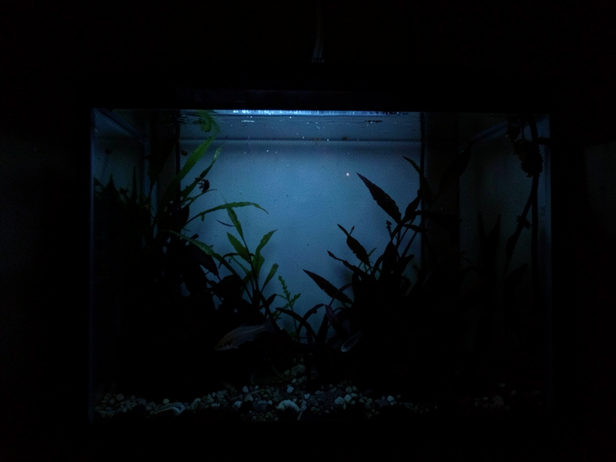
![Aquarium's Nocturnal Glow]()
Aquarium's Nocturnal Glow
Image credit : AI
I notice my fish look pale in the dark; is this normal or a sign of illness?
When to stop watching and call a vet or aquatic specialist
Colour fading that does not reverse when the lights come on, fading that is patchy or covers only part of the body, or fading that comes with any change in behaviour or appetite, these are the signs that warrant a proper look. An aquatic vet or a specialist fish retailer with diagnostic capability can assess water quality, rule out parasites, and advise on treatment. Waiting to see if it resolves on its own is reasonable for one or two days; beyond that, the fish is telling you something the lights cannot fix.