The puddle appears the second you crouch down to say hello. Your dog isn't confused about where to go, it knows perfectly well. The small release of urine is a social signal, one that dogs have been using with each other long before they lived with people.
What the dog is actually doing
Submissive urination is an appeasement behaviour. When a dog perceives a greeting as socially intense, a person leaning over it, making direct eye contact, reaching a hand toward its head, it responds the way a lower-ranking dog would respond to a more dominant one: by making itself as unthreatening as possible. A flattened posture, ears back, tail tucked, and a small release of urine are all part of the same signal. The urine itself carries scent information that tells the other party: I am not a threat.
This is distinct from excitement urination, where the dog is simply overwhelmed by the stimulation of a reunion and loses bladder control briefly. Excitement urination tends to happen with bouncing and spinning; submissive urination happens with cowering. The two can overlap, but the body language tells them apart. Both are involuntary, the dog is not choosing to urinate and cannot be punished out of it.
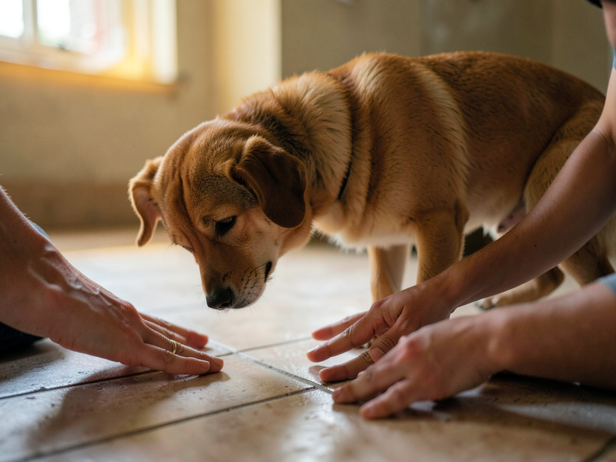
![Gentle Approach, Open Hands]()
Gentle Approach, Open Hands
Image credit : AI
Observing appeasement behaviour, a dog cautiously approaches open hands, seeking reassurance in a peaceful setting.
Why some dogs do it and others never do
Puppies are the most common candidates, because the appeasement reflex is strongest when a dog is still working out its place in a social world. Many dogs simply grow out of it as they gain confidence, usually by the time they are a year old. Adult dogs that still do it tend to fall into one of two groups: those with a generally anxious temperament, and those who learned early that humans respond unpredictably to normal dog behaviour, scolding, looming, or physical correction that the dog could not make sense of.
Breed plays a smaller role than temperament. Softer, people-oriented dogs that are highly attuned to human body language, Cocker Spaniels, some retrievers, many Indie dogs that have had uncertain early experiences, show it more often. But any dog can do it, and the absence of it says nothing about confidence or training quality.
What makes it worse
The greeting itself is usually the trigger, and most greetings that feel natural to people feel socially loaded to a dog. Leaning forward, reaching over the top of the head, sustained eye contact, a loud cheerful voice directed straight at the dog, all of these read as social pressure. The dog responds by escalating its appeasement, which means more urine, not less.
Scolding after the fact makes it worse in a specific way: the dog does not connect the correction to the urination. It connects it to the greeting. The next greeting carries even more social anxiety, and the reflex becomes more entrenched. Cleaning up without any reaction and moving on is genuinely the better response, not just the kinder one.
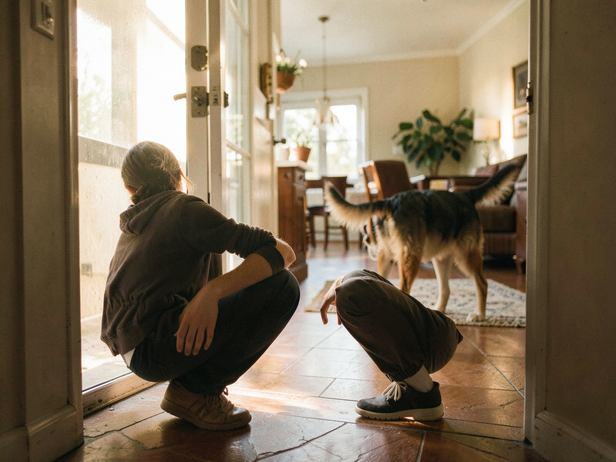
![Waiting by the Doorway]()
Waiting by the Doorway
Image credit : AI
A moment of quiet anticipation as a dog approaches, exhibiting appeasement behaviour. The late afternoon sun casts a warm glow.
How to reduce it
The goal is to lower the social intensity of the greeting until the dog's threshold is no longer crossed. This takes consistent repetition over several weeks, not a single session.
Come in without announcing yourself. Ignore the dog for the first minute or two after you walk through the door. Let the initial arousal settle before any interaction begins. When you do greet the dog, crouch sideways rather than facing it directly, avoid eye contact, and let it approach you rather than reaching toward it. Scratch under the chin or on the chest rather than over the top of the head. Keep your voice low and calm.
Ask visitors to do the same. One person following the protocol while others continue with loud, leaning greetings will slow progress considerably. If a visitor cannot manage it, have the dog on a lead so you can redirect it before the greeting happens, or greet it outside where the context feels different.
For dogs with a generally anxious temperament, confidence-building through positive reinforcement training helps over time. Short, successful training sessions where the dog gets things right and is rewarded for it shift the dog's general emotional baseline. A dog that feels competent in its world is a dog that needs to appease less.
When to involve a vet
Submissive urination in a puppy under a year old, with no other concerning signs, is almost always a developmental phase. But a few situations warrant a vet visit before assuming it is purely behavioural. If a dog that previously had reliable bladder control suddenly starts leaking during greetings, a urinary tract infection, a hormonal issue, or a neurological cause needs to be ruled out. If the urination is happening throughout the day rather than only at moments of social interaction, that is a medical question, not a training one. Spayed females can develop urethral sphincter incompetence that presents similarly; it is treatable, and a vet can distinguish it from behavioural submissive urination in a straightforward examination.
Submissive urination that persists well into adulthood despite consistent low-key greetings is worth a conversation with a veterinary behaviourist. The reflex is usually manageable at home, but some dogs carry enough underlying anxiety that they benefit from a more structured behaviour plan.