If you have a herding breed at home and find yourself doing a little shuffle every time you walk across the room, you are not imagining it. That nip at your ankle, the grab at a trouser leg, the low crouch followed by a dart, this is not a dog misbehaving. It is a dog doing precisely what centuries of selective breeding shaped it to do, in a flat with no sheep in sight.
The instinct behind the nip
Herding dogs, Border Collies, Australian Shepherds, Shetland Sheepdogs, Corgis, and to a lesser extent Belgian Malinois and German Shepherds, were bred to control the movement of livestock. The core tool in that job is a controlled, inhibited bite at the heel or flank of an animal that strays from the group. It is not a predatory bite meant to injure. It is a pressure cue: move this way, not that way.
The behaviour is called heeling or ankle nipping, and in working dogs it is a finely tuned skill. The dog reads movement, anticipates direction, and applies just enough contact to redirect. The problem in a home is that the trigger, moving bodies, is still there, and the behaviour is still switched on, but there are no sheep to justify it. Your children running down the corridor, your guests walking toward the kitchen, your own feet moving across the floor: all of these look, to a herding dog's nervous system, like something that needs to be gathered.
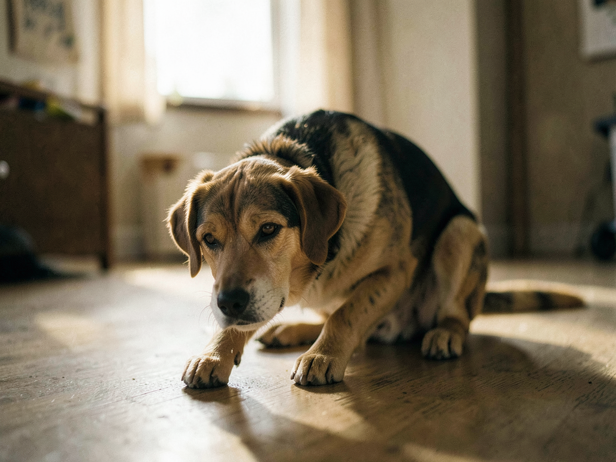
![Herding Dog's Alert Stance]()
Herding Dog's Alert Stance
Image credit : AI
My herding breed exhibits its natural instinct, a low alert crouch on the apartment floor, ready for action.
Why puppies do it more, and why it doesn't always stop on its own
Herding instinct tends to intensify in puppies between twelve and twenty weeks, when they begin practising behaviours that feel rewarding. A nip at a moving ankle produces a reaction, a yelp, a sudden stop, a turn, and that reaction is information. The dog learns that the behaviour works. Without intervention, it becomes a habit reinforced by its own results.
Adult herding dogs that were not redirected early can nip with more confidence and more pressure. The bite inhibition that makes a working dog's nip safe does not always transfer cleanly to a pet that has never learned what it is supposed to be doing instead. This is also why the behaviour tends to escalate around children, who move quickly and unpredictably and who react loudly, exactly the feedback loop that tells a herding dog it is doing something effective.
Pain, illness, or cognitive changes can also cause a dog that previously did not nip to start. If the behaviour appears suddenly in an adult dog with no herding history, or intensifies sharply, a vet check is the right first step before attributing it to instinct.
What actually helps
The goal is not to suppress the instinct, that is neither realistic nor fair to the dog. The goal is to give it a legal outlet and to teach the dog that moving people are not livestock.
Management comes first. When the dog is in a state where nipping is likely, guests arriving, children playing, a busy household moment, keep it on a lead attached to you, or behind a baby gate. This is not punishment. It is preventing the rehearsal of a behaviour you do not want to become more ingrained.
Redirection is the core tool. The moment the dog orients toward a moving ankle, the low crouch, the stalk, the fixed gaze, interrupt it with a cue it already knows, such as sit or look, and reward that response immediately. You are not waiting for the nip and then reacting. You are catching the beginning of the sequence and giving the dog something else to do with that energy.
Structured exercise and mental work matter more for herding breeds than for most others. A Border Collie or Malinois that has had two hours of physical exercise and thirty minutes of scent work or training is a different animal from one that has been in a flat since morning. The nipping often increases when the dog is under-stimulated, because the herding circuitry is looking for something to do.
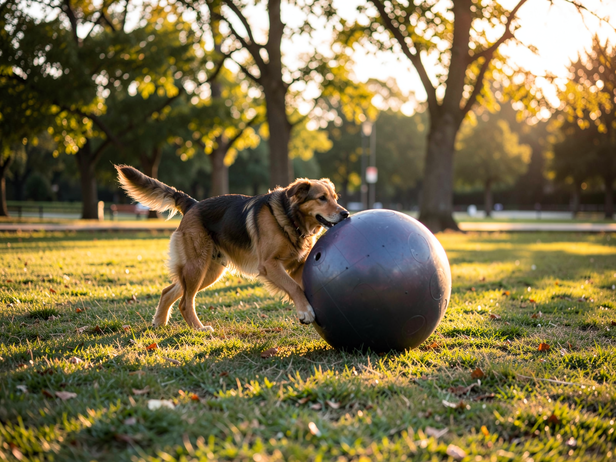
Fetch, tug with rules, and herding-specific sports like treibball, where the dog pushes large exercise balls into a goal, give the instinct a directed outlet. These are not cures, but they reduce the pressure that makes the behaviour spill over onto people.
![Dog's Golden Hour Play]()
Dog's Golden Hour Play
Image credit : AI
My herding dog's instinct shines as it plays with a large ball, a common behavior for breeds like Border Collies.
When to bring in a professional
A qualified trainer or veterinary behaviourist is the right next step if the nipping draws blood, if it is directed at a child who is frightened, if the dog cannot be interrupted once it has started the sequence, or if the behaviour is getting more intense despite consistent redirection at home. Herding instinct is manageable, but when bite pressure is increasing rather than decreasing, that is not a training problem you should be working through alone.
The instinct that makes a herding dog extraordinary at its original job is the same one that makes it complicated to live with in a city flat. Knowing that the nip is a communication, not defiance, not aggression, changes how you respond to it, and that change is where the work begins.