A growl is a dog's most honest sentence. It means: I am uncomfortable, I am afraid, or I need this to stop. Owners who punish it, a sharp "no", a scruff, a spray of water, do not teach the dog to feel safer. They teach it that warning you is dangerous. The growl disappears. The bite does not.
What growling actually is
Growling sits in the middle of a dog's threat ladder, between subtle signals most owners miss and a bite they cannot miss. Below the growl: a stiffened body, a hard stare, a tucked tail, a whale eye, the white of the eye showing at the corner. Above it: a snap, a bite. The growl is the dog trying to resolve the situation without escalating. It is, by any measure, a good thing. The dog is communicating rather than acting.
Veterinary behaviourists call this the aggression ladder, and it matters because removing one rung does not shorten the ladder. It removes the dog's ability to warn. A dog that has been punished repeatedly for growling learns to skip it. The bite, when it comes, appears without warning, and owners describe it as coming out of nowhere. It did not. The nowhere was built, one punishment at a time.
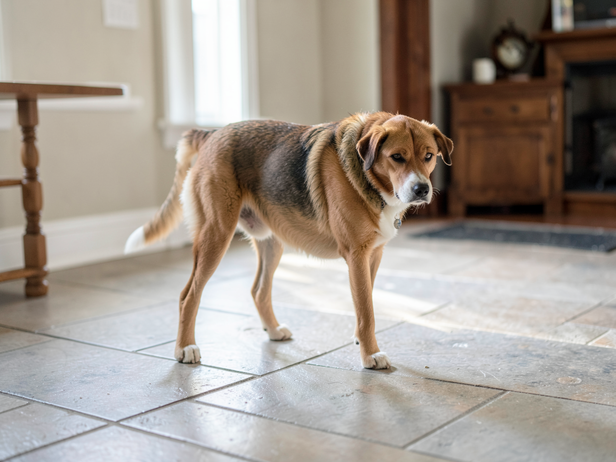
![Tense dog on cool tiles]()
Tense dog on cool tiles
Image credit : AI
This dog's body language, with flattened ears and shifted weight, signals a warning. Understanding dog growling behavior is crucial.
The causes behind the growl
Growling has several explanations, and the right response depends on which one is operating. The most common:
Fear is the most frequent driver of growling in pet dogs. A stranger reaches toward the dog's face. A child runs at it. A hand comes toward a dog that is eating. The dog is not being dominant, it is scared, and it is saying so.
Pain is the explanation that owners miss most often. A dog that suddenly growls when touched in a place it previously accepted may be in pain at that site. Arthritis, an ear infection, a sore joint, an injury that has not yet been found. Any new or sudden growling in a dog that was not previously reactive is worth a vet visit before any behaviour work begins.
Resource guarding, food, a toy, a resting spot, sometimes a person, is a normal dog behaviour, more pronounced in some individuals than others. It is also one of the most trainable, with a qualified behaviourist and a reward-based approach.
Cognitive decline in older dogs can produce growling that seems out of character. Canine cognitive dysfunction changes how a dog processes its environment, and a senior dog that growls unpredictably deserves a vet assessment before the behaviour is treated as a training problem.
What to do when your dog growls
Stop. Do not punish the growl. Do not push through whatever triggered it to prove a point. The dog has told you something is wrong; the productive response is to find out what.
If the growl happened in a specific context, near the food bowl, when a child approached, when you touched a particular spot, note it. That context is information. It tells you what the dog finds threatening, and it gives you and a qualified trainer something to work with.
If the growl is new, sudden, or out of character, rule out pain first. A vet visit is not an overreaction. It is the correct first step when behaviour changes without an obvious trigger.
If the growl is part of a pattern, around food, around strangers, around children, a certified veterinary behaviourist or a qualified reward-based trainer is the right next step. Resource guarding and fear-based reactivity both respond well to counter-conditioning and desensitisation, done correctly and at the dog's pace. They do not respond to punishment, which increases the fear that is usually driving the behaviour in the first place.
![Morning Light on Empty Bowl]()
Morning Light on Empty Bowl
Image credit : AI
An empty bowl awaits, a silent testament to a meal finished. Understanding dog aggression communication is key.
The one thing that makes bites more likely
Suppressing the growl. It is the single most consistent finding in veterinary behaviour literature on dog bites: dogs that have been punished for growling bite without warning. The owner reports that the dog gave no sign. The dog gave every sign it had left.
A dog that growls is a dog that is still communicating. That is a dog you can work with, one that is telling you what it needs before the situation becomes one neither of you can walk back from. Keeping the growl means keeping the conversation open. That is where safety lives, not in the silence that follows punishment.