The grey arrives at the muzzle first. Then the hips take a moment longer to straighten after a rest, and the dog who once met you at the door before you touched the handle now lifts his head from the bed and decides whether the walk to the hallway is worth it. You are not imagining the change. You are also not ready for it, and those two things can be true at the same time.
What you are feeling has a name
Anticipatory grief is the sorrow that comes before a loss, not after it. It is well documented in humans watching a parent decline, and it is increasingly recognised in pet owners watching an animal age. The feeling is not irrational or premature. The dog in front of you is genuinely different from the dog you had three years ago. A part of that earlier relationship has already ended. Grieving it is accurate, not melodramatic.
The guilt that often accompanies the grief is worth examining separately. Many owners feel they are failing a dog who is slowing down, not walking him far enough, not playing enough, not doing something they cannot name. That guilt is almost always misplaced. A dog in his senior years is not disappointed by a shorter walk. His world has contracted to match his body, and what he wants from you has not changed: proximity, a predictable routine, and the knowledge that you are still there.
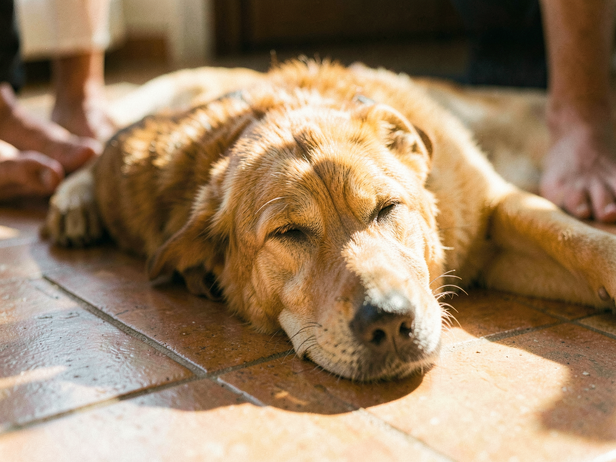
![Senior dog's sunbeam nap]()
Senior dog's sunbeam nap
Image credit : AI
My senior dog enjoys a peaceful morning nap, a familiar sign of ageing dog behaviour. Quiet moments of companionship.
What is actually happening in an ageing dog's body
Dogs age faster than people, and large breeds age faster than small ones. A seven-year-old Labrador is physiologically closer to a person in their mid-fifties than to one in their thirties. The changes you are seeing are real biological shifts, not mood or laziness.
Joint cartilage thins over time, making movement genuinely uncomfortable in ways the dog cannot report. The senses dull, hearing often goes first, then vision in low light, then the precision of smell that once made a walk a full sensory event. Cognitive function can also change: some dogs develop canine cognitive dysfunction, a condition with real neurological changes that resembles dementia in humans. A dog who seems confused at night, who stands in corners, who forgets a house-trained routine he has followed for years, that is not stubbornness. That is a brain working differently than it once did, and it is worth a conversation with a vet rather than a training correction.
Pain is the variable most owners underestimate, because dogs do not cry out the way people do. A dog who has stopped jumping onto the sofa, who hesitates at stairs, who snaps when touched in a place he once welcomed, that dog may be in pain. Behavioural change in a senior dog is a reason to rule out a physical cause before assuming anything else.
What your dog needs from you now
The relationship shifts, but it does not diminish. What an older dog needs is largely what he has always needed, adjusted for what his body can do.
Routine matters more than it did when he was young and adaptable. A predictable schedule, meals, short walks, rest, gives a dog with declining senses and possibly some cognitive change a framework he can rely on without having to work out where he is in the day. Disruption that a younger dog shrugged off can genuinely unsettle a senior one.
Physical contact remains important, sometimes more so. A dog whose hearing and vision are fading uses touch and scent to confirm you are still present. Sitting near him, a hand resting on his side while he sleeps, these are not sentimental gestures. They are information he needs.
Mental engagement should be scaled, not eliminated. A dog who cannot run a kilometre can still use his nose. Slow sniff walks, ten minutes at his pace, following whatever he wants to smell, are neurologically richer for an older dog than a brisk walk where he trots beside you without stopping. Let him lead the pace and the direction. The point of the walk has changed.
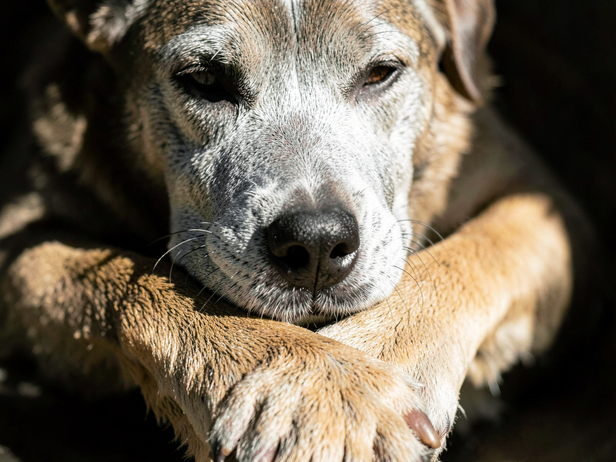
![Grey Muzzle, Gentle Rest]()
Grey Muzzle, Gentle Rest
Image credit : AI
My grey muzzle rests, a sign of ageing dog behaviour. I find comfort in the quiet light.
When behaviour change means a vet visit
Not every change in an old dog is simply ageing. Some changes are treatable conditions wearing the mask of old age, and catching them early makes a difference.
If your dog stops eating for more than a day, drinks noticeably more or less water than usual, loses weight without a change in diet, shows sudden aggression or fear where there was none before, or seems disoriented in familiar spaces, those are signs that need a vet's eyes, not a wait-and-see approach. Pain management for arthritis, medication for cognitive dysfunction, and treatment for thyroid or organ changes can meaningfully improve the quality of the time he has. Assuming a symptom is just age means sometimes missing something fixable.
A senior wellness check once or twice a year, more frequent than the annual visit you may have managed when he was young, gives a vet the baseline to spot what is changing and how fast.
Living in the time you have
There is a particular kind of attention that becomes possible once you accept that a dog is old. The urgency of puppyhood is gone. The project of training is largely finished. What remains is the animal himself, his specific smell, the way he positions himself in a room, the particular quality of his attention when you speak to him.
Owners who have been through this often say the same thing afterward: the last years were slower, and the slowness turned out to be a gift. Not because loss was not coming, but because the pace of those years made presence easier. You were not rushing him through a walk to get to something else. You were just there, with a dog who was also just there, for as long as that lasted.