Most pet owners notice it without quite naming it: a shift in the animal's behaviour that begins well before the door closes. The pacing, the following from room to room, the sudden neediness or the pointed withdrawal. It starts earlier than you expect, sometimes the moment you silence your alarm, and it has nothing to do with coincidence.
Your routine is a script your pet has memorised
Pets do not read time on a clock, but they read time through sequence. Every morning you follow roughly the same order, alarm, bathroom, kettle, clothes, bag. Each step is a cue that predicts the next, and the last cue in the chain predicts your absence. Through simple associative learning, the kind Ivan Pavlov documented with dogs over a century ago, your pet links the early steps in that chain to the outcome: you leave. By the time you reach for your keys, the animal is not reacting to the keys. It is reacting to everything that came before them, because those things have reliably ended the same way every time.
![Morning Departure Essentials]()
Morning Departure Essentials
Image credit : AI
My worn shoes and bag are ready. I wonder if my pet feels anticipatory anxiety before I leave.
The signals they track are finer than you realise
Research on domestic dogs has shown they can distinguish between an owner's work shoes and casual shoes, between a bag packed for a short trip and one packed for a long one, and between a shower taken on a weekday morning and one taken on a weekend. Cats, often assumed to be indifferent, show measurable stress indicators, elevated heart rate, changes in grooming pattern, before departures, even if they display it less obviously than dogs. The animal is not reading your mind. It is reading your body: the pace of your movement, the clothes you reach for, the smell of a pressed shirt versus a worn one, the particular way you move through the flat when time is short.
Anticipatory anxiety is different from separation anxiety
These two are related but not the same, and the difference matters for what you do about it. Separation anxiety is distress that peaks after you leave and sustains itself through your absence, destructive behaviour, vocalisation, house soiling in a trained animal, refusal to eat. Anticipatory anxiety is the distress that builds in the window before departure. An animal can have one without the other, though they often travel together. If your pet settles within twenty minutes of your leaving, the anxiety was anticipatory. If a neighbour can hear your dog an hour after you have gone, or if you return to evidence of sustained distress, that is separation anxiety and it warrants a conversation with a vet or a qualified animal behaviourist. The two conditions respond to different approaches.
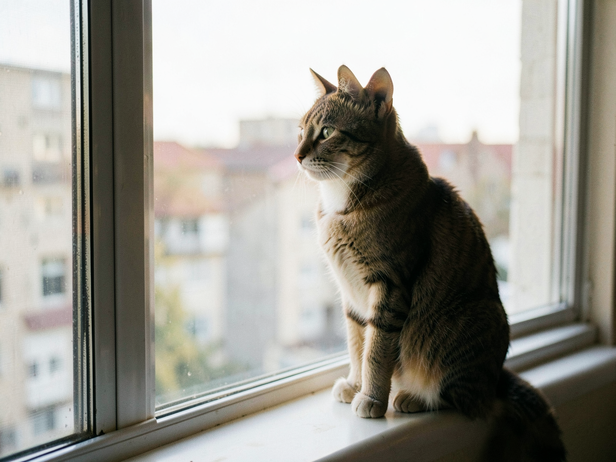
![Cat's Morning Watch]()
Cat's Morning Watch
Image credit : AI
I watch the world outside, a silent sentinel. Sometimes, I wonder why pets get restless before owners leave.
What drives the restlessness specifically
Several things are happening at once. First, the animal has no way to resolve the uncertainty, it cannot ask when you will be back, and it cannot follow you. The inability to act on a predicted aversive event is itself stressful. Second, the attachment bond between a pet and its primary caregiver is physiologically real: cortisol rises in dogs during owner absence, and oxytocin rises during reunion. The restlessness before departure is, in part, the animal's stress system activating in response to a learned predictor of that separation. Third, some of the behaviour owners read as restlessness is actually attention-seeking, the animal has learned, correctly, that looking distressed sometimes delays your departure or produces extra contact before you go. That learned behaviour is reinforced every time it works.
What you can do, and what makes it worse
Long, emotional goodbyes feel kind but tend to amplify the signal. The more weight you give the departure moment, the more salient it becomes as a cue. A calm, brief leave-taking, no prolonged eye contact, no repeated reassurances, removes some of that salience over time. Varying the order of your morning routine, where possible, breaks the predictive chain. Picking up your keys and then sitting back down, repeatedly and without leaving, is a standard desensitisation exercise that reduces the keys' power as a trigger. Giving your pet something engaging, a food puzzle, a filled Kong, a favourite object, just before you leave shifts its attention toward something rewarding at the moment the departure cue fires. None of these changes work in a week. Consistent repetition over several weeks is what changes the association.
When the restlessness is not about your departure at all
Pain and illness can produce restlessness that coincides with morning activity without being caused by it. A dog with joint pain may pace more when the household becomes active because movement hurts and the stimulation is unwelcome. An older cat that seems more anxious or vocal in the mornings may be showing early signs of hyperthyroidism or cognitive decline rather than separation-related distress. If the restlessness is new, has intensified suddenly, or is accompanied by other changes, appetite, drinking, sleep, elimination, a vet visit is the right first step before any behavioural intervention. Treating the behaviour without ruling out a physical cause is working on the wrong problem.