You are three minutes into the morning walk when your dog locks onto something invisible in the grass, freezes, then folds sideways and begins grinding his neck and shoulders into whatever he has found. By the time you pull him off, he smells like a drain. This is one of the most reliably baffling things dogs do, and it has at least three credible explanations, none of which involve your dog trying to humiliate you.
The scent-masking theory: a hunting inheritance
The oldest and most discussed explanation is that dogs roll in strong odours to mask their own scent. Wild canids hunting prey animals benefit from approaching without advertising themselves. Covering your natural smell with something the prey does not associate with danger, a carcass, dung, rotting vegetation, could close the gap between hunter and meal. Dogs are not hunting anything on your morning walk, but the neural wiring that made the behaviour useful in a wild ancestor did not get edited out when dogs moved into homes. Behaviour that was once functional can persist long after the function disappears. The problem with this theory is that it is difficult to test cleanly in domestic dogs, and not all researchers find it convincing as the sole driver.
![Golden Hour on the Trail]()
Golden Hour on the Trail
Image credit : AI
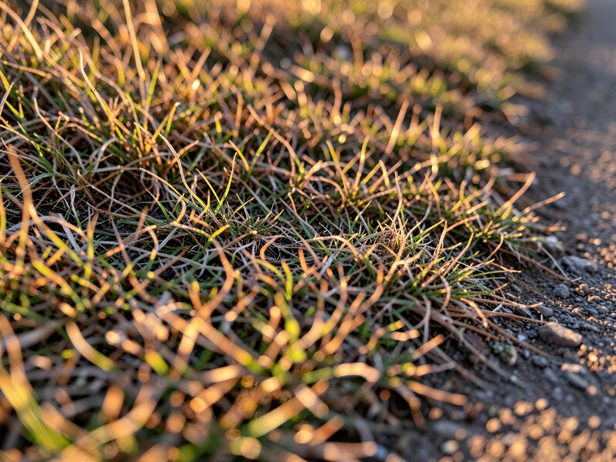
A faint dog scent rolling impression on the footpath, bathed in warm morning light.
The scent-communication theory: bringing news home
A second explanation, which has some support from observations of wolves, is that rolling in a novel smell is a way of carrying information back to the group. A wolf that returns to the pack smelling of something unfamiliar prompts other pack members to investigate, sniffing the roller, then potentially following the scent trail back to the source. In this reading, rolling is less about disguise and more about communication: the dog is, in a sense, wearing a message. Whether domestic dogs retain this social function in a meaningful way is unclear, but the behaviour pattern has been documented in wolves and is plausible as a shared ancestral root.
What the dog is actually getting out of it
Whatever the evolutionary origin, the immediate experience for the dog is clearly rewarding. Dogs have scent receptors estimated at forty times more numerous than a human's, and they process smell as a primary channel for understanding the world. A powerful, complex odour is genuinely interesting to a dog in a way that a human standing next to the same smell cannot easily imagine. Rolling may be the equivalent of wanting to be inside something fascinating rather than just near it. The behaviour is almost always accompanied by visible signs of pleasure, loose body, open mouth, sometimes vocalisation. The dog is not distressed. He is delighted.
![Dog's Keen Sense of Smell]()
Dog's Keen Sense of Smell
Image credit : AI
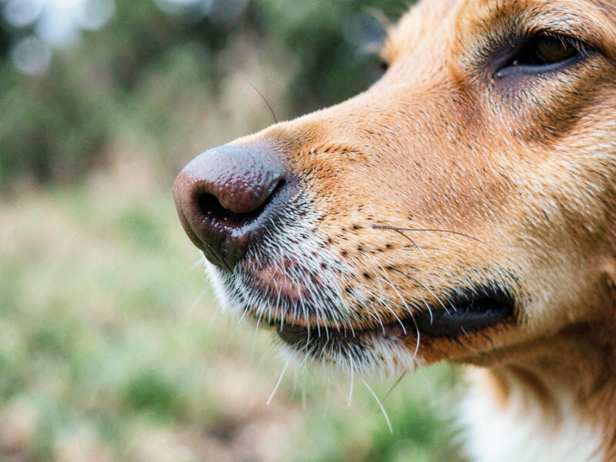
Exploring the world through scent. My nose twitches, ready to investigate why dogs roll in smelly things.
Why some dogs do it more than others
Not every dog rolls in every disgusting thing, and the variation is real. Breed history plays a role: dogs bred for scent work, hounds, spaniels, retrievers, tend to show the behaviour more often, which fits with a stronger overall orientation toward smell. Individual dogs also differ in how much environmental novelty they seek. A dog who is under-stimulated on walks, who does not get enough sniffing time, or who finds the walk itself boring may roll more frequently than a dog who is mentally occupied throughout. If your dog is consistently rolling and you want to reduce it, the more useful question is whether the walk is giving him enough to engage with, not just enough distance to cover.
When rolling is worth a closer look
Rolling in smelly things is normal dog behaviour and not a health concern on its own. The practical problem is whatever the dog has rolled in. Some substances found on urban walks, pesticide-treated grass, certain fertilisers, decomposing animals, can irritate the skin or be absorbed through it. If your dog rolls and then shows redness, itching, excessive licking of the coat, vomiting, or unusual lethargy within a few hours, that is worth a call to your vet rather than a wait-and-see. A dog who suddenly starts rolling far more than usual, or who rolls indoors on clean surfaces, may be experiencing skin irritation or discomfort worth checking, rolling can occasionally be a response to an itch the dog cannot reach any other way. The behaviour itself is ancient and harmless; what he rolled in is the variable that matters.