A lone neon tetra in a bare tank is not just unhappy, it is physiologically stressed. Its cortisol equivalent rises, its immune response dips, and its colour dulls. The fish is not being dramatic. It is responding to a real threat signal that evolution has spent millions of years calibrating.
What schooling actually is
Schooling and shoaling are often used interchangeably, but they mean different things. A shoal is any group of the same species staying loosely together. A school is a shoal moving in coordinated synchrony, same direction, same speed, tight spacing. Tetras do both: they shoal at rest and school when startled or swimming actively.
The coordination happens through two sensory systems working together. The lateral line, a row of pressure-sensitive cells running along each side of the fish's body, detects tiny changes in water movement made by its neighbours. The eyes handle visual spacing. Together they let a tetra respond to the fish next to it in under 20 milliseconds, faster than a conscious decision in any vertebrate. The result looks choreographed because, in a mechanical sense, it is.
![Golden Light on Water Surface]()
Golden Light on Water Surface
Image credit : AI
I see the gentle ripple patterns and golden light on the aquarium surface, hinting at the peaceful world of schooling fish.
Why the group is safer than the individual
Predator confusion is the core benefit. A single fish is easy to track. A hundred fish moving as one shifting mass is not. A predator targeting one individual loses it the moment the school turns. This is called the confusion effect, and it is well-documented across schooling species from sardines to tetras.
There is also the dilution effect: in a group of fifty fish, each individual's statistical chance of being the one eaten drops sharply. And many-eyes detection means a threat spotted by one fish at the edge of the school triggers a startle wave through the whole group before most members have even seen the predator. The fish in the middle of a school are the safest. Watch your tetras, the boldest ones lead; the most anxious sit deep in the group.
What happens when the group is too small
The threshold for genuine schooling behaviour in most tetra species sits around six fish. Below that number, the coordination breaks down. Individual fish start making independent decisions, the group fragments under mild stress, and the predator-confusion effect disappears. A tank with three neon tetras does not have a school, it has three isolated fish that happen to share water.
Chronic understocking shows in behaviour before it shows in health. Fish hover near cover rather than swimming openly. Colours stay muted. Feeding becomes hesitant. In species like cardinal tetras and rummy-nose tetras, which are particularly tight schoolers, a small group will often press into one corner and barely move. This is not shyness. It is a low-grade fear response that does not switch off because the safety signal, the group, is never large enough to register.
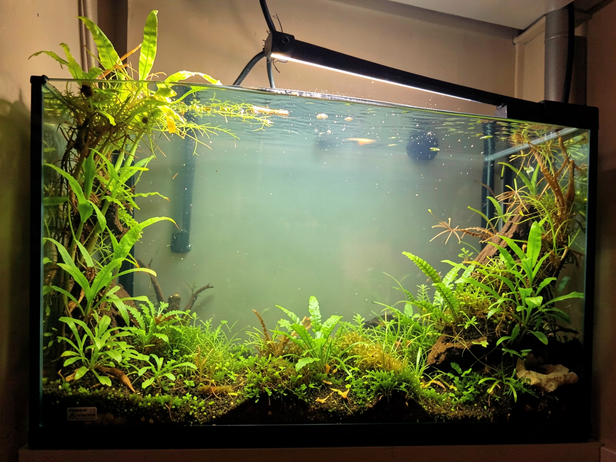
![Planted Aquarium Depth]()
Planted Aquarium Depth
Image credit : AI
I admire the atmospheric, soft warm light illuminating this planted aquarium, showcasing the beauty of schooling fish behavior.
Setting up a tank that lets tetras behave normally
The practical minimum for most tetra species is ten to twelve fish of the same species. This gives the school enough members to form and enough redundancy that losing one or two does not collapse the dynamic. Mixed-species tanks can work, neons and cardinals will school loosely together because their size and movement patterns are similar, but the tightest schooling happens within a species.
Tank shape matters more than most owners expect. A long, horizontal tank lets a school complete a full turn without hitting glass, which is the movement that makes schooling look natural rather than panicked. A tall, narrow tank gives the fish nowhere to go laterally and produces the corner-hovering that owners often mistake for illness.
Lighting and planting affect how secure the fish feel at rest. A heavily planted tank with open swimming space in the centre mirrors the structure of the shallow, vegetated rivers where most tetras evolved, dense cover at the edges, open water in the middle where the school can see threats coming from a distance.
When behaviour is worth watching more closely
A well-stocked school of healthy tetras swims in the open, feeds readily, and moves as a group when startled but spreads out again within seconds. Persistent hiding in a correctly sized group, fish sitting at the surface or the bottom rather than mid-water, loss of colour that does not recover after lights-on, or one fish being chased repeatedly by others, these are signs that something beyond group size is wrong. Water quality, disease, and incompatible tank mates all produce behavioural changes before physical symptoms appear. If the school looks wrong and adjusting numbers and layout does not help within a week, a vet with fish experience or an aquatic specialist is the right next step.
The schooling instinct is not a quirk or a personality trait, it is the operating system the fish runs on. A tetra kept in a group large enough to school is not just more pleasant to watch. It is living in the conditions its biology was built for.