A hamster can carry food weighing almost half its own body weight inside its cheeks. That is not an exaggeration, the pouches extend from the mouth all the way back past the shoulders, sitting between the skin and the muscle wall on each side. Most pet owners see the stuffed face and laugh. What they are watching is a survival mechanism so effective that evolution has barely touched it in thousands of years.
What the pouches actually are
The cheek pouches are not simply a stretchy mouth. They are distinct, dry-walled sacs with their own muscular lining, separate from the digestive tract. Because they have no salivary glands of their own, food stored inside does not begin to break down, the hamster is carrying a sealed larder, not a stomach extension. A Syrian hamster's pouches can expand to roughly three times the size of its head when full. Dwarf hamsters, including Roborovski and Campbell's, have proportionally similar pouches relative to their smaller bodies. The sacs empty by a squeezing motion: the hamster uses its front paws to push from the back of the pouch forward, compressing the contents out through the mouth.
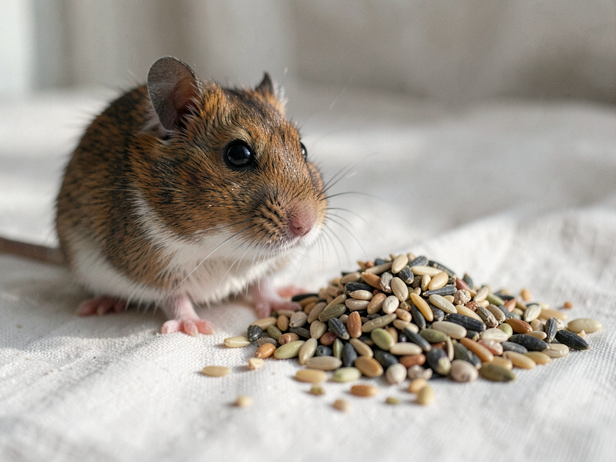
![Hamster with Seed Stash]()
Hamster with Seed Stash
Image credit : AI
I'm preparing my hoard! Understanding why hamsters stuff their cheeks helps me care for them.
Why wild hamsters evolved this behaviour
Wild hamsters, the Syrian hamster comes from the arid grasslands of northern Syria and southern Turkey, forage across wide, open ground where predators are common. Stopping to eat in the open is dangerous. The pouch system solves this by letting the animal collect food fast and carry it back to a burrow, where it can eat or cache in safety. A single foraging run can fill both pouches with seeds, grains, and plant matter, then be deposited underground. Some wild hamsters have been found with burrow caches holding several kilograms of food, months of supply built up across hundreds of trips. The behaviour is not about hunger in the moment; it is about reducing time spent exposed above ground.
What your pet hamster is actually doing when it pouches
A pet hamster has no predators and a bowl that refills reliably, but the drive to cache has not switched off. When your hamster stuffs its cheeks and then runs to a corner of the cage to empty them, it is performing the full ancestral sequence: collect, transport, deposit. The corner becomes the burrow. The food pile under the bedding is the cache. This is why hamsters will pouch food even immediately after eating, the motivation is not current hunger but the compulsion to move resources to a safe location. It also explains why hamsters often hoard the same food repeatedly: they will carry it to the cache, then bring it back out, then re-cache it. The behaviour is self-reinforcing.
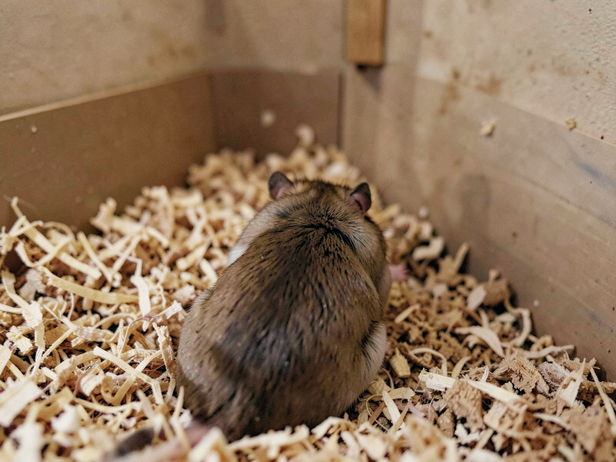
![Hamster diligently nests]()
Hamster diligently nests
Image credit : AI
I'm busy stuffing my cheeks with bedding to make my home perfect. Hamster cheek pouches are amazing!
When pouching becomes a problem worth watching
The pouches are generally robust, but two things can go wrong. First, sticky or sharp foods, certain seeds with hard husks, dry bread, or anything tacky, can get lodged inside and cause an impaction. A hamster that is repeatedly trying to empty its pouches, pawing at its face, or has one side visibly swollen but not emptying on its own needs a vet. Pouch impactions do not resolve without help. Second, hamsters can develop pouch eversions, where the lining turns inside out and protrudes from the mouth as a pink mass. This looks alarming and is an emergency, it requires veterinary attention the same day. Outside of these two conditions, a hamster stuffing and emptying its pouches normally is doing exactly what it is built to do.