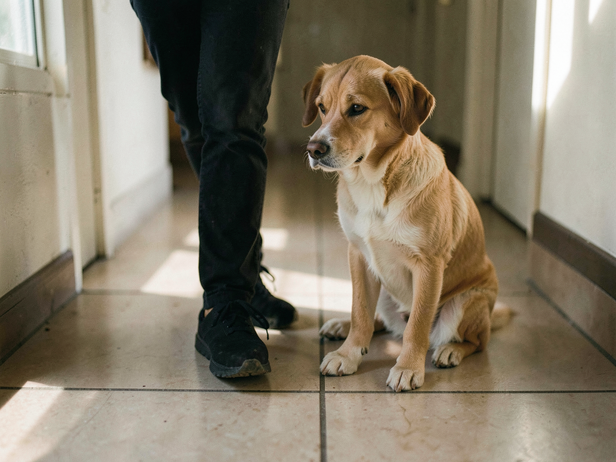
Watch your dog on three consecutive walks and you will likely notice it gravitates to the same side of your body each time. It is consistent enough to feel deliberate, and it is.Dogs are not symmetrical in how they process the world. Like humans, they show a functional bias between their left and right sides, in the brain, in the senses, and in how they respond to what they encounter. Where your dog positions itself on a walk is one place that bias shows up in plain sight.
The brain is not the same on both sides
![Calm Dog Beside Owner]()
Calm Dog Beside Owner
Image credit : AI
A dog's attentive, relaxed posture beside its owner. Understanding why dogs walk on one side can deepen your bond.
In dogs, as in most vertebrates, the left and right hemispheres of the brain handle different kinds of input. The right hemisphere processes novel stimuli, threat, and strong emotion. The left hemisphere handles familiar, routine, and positive social interaction.Because each hemisphere controls the opposite side of the body, a dog that positions itself on your left side is keeping its left eye and left ear toward you, feeding information about you into its right hemisphere, which handles social bonding and emotional reading. A dog that walks on your right keeps its right side toward you, routing that same input to the left hemisphere instead.Researchers studying lateral bias in dogs have found that the side a dog chooses when approaching a familiar person is not random. It tends to be consistent within individual dogs and correlates with how the animal processes social and emotional signals. The behaviour is not trained into them. It emerges from how their nervous system is organised.
What the left side usually signals
Dogs that consistently walk or lean to your left are keeping you in their right hemisphere's field, the hemisphere associated with processing the emotional content of a relationship. This is the same side dogs tend to use when approaching a person they are bonded to and trust.If your dog has always gravitated left and is relaxed on walks, this is almost certainly a sign of secure attachment. The dog is orienting toward you as a social anchor, not just a direction of travel.
What the right side usually signals
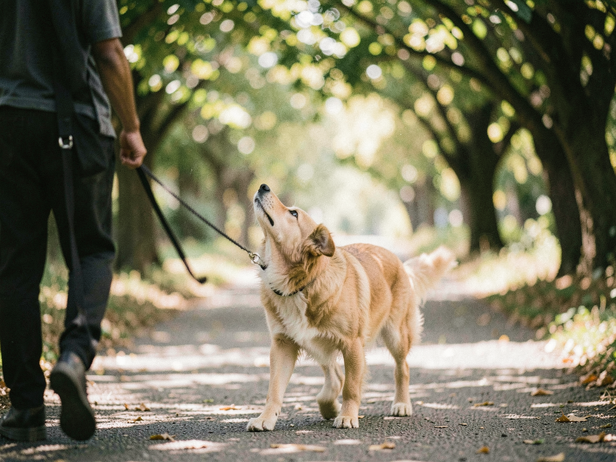
![Dog's Gentle Walk Companion]()
Dog's Gentle Walk Companion
Image credit : AI
A dog's lateral preference in action, walking faithfully on the left. This quiet moment highlights the bond during a peaceful stroll.
A dog that walks to your right is not less attached. The right side of the body is controlled by the left hemisphere, which in dogs is associated with routine, familiar positive experience, and approach behaviour in calm contexts.Some dogs choose the right because that is where the leash attaches, where treats have historically come from, or simply where they first learned to walk beside a person. Trained dogs in obedience work are conventionally positioned on the left, so a dog with no formal training and a relaxed owner may default to the right simply because nothing pushed it the other way.A dog that switches sides depending on what it encounters, moving to the left when something unfamiliar appears, drifting right when the walk is calm, is showing lateral flexibility. That is not inconsistency. It is the bias adjusting to context.
When the environment is doing the choosing
Not every side preference is neurological. Dogs also position themselves in response to what is around them.A dog walking in a busy Indian market lane will often tuck itself between you and a wall, regardless of which side that puts it on. A dog that has been startled by traffic on one side will move away from it. A dog that smells something interesting will drift toward the source.The preference worth paying attention to is the one that persists across different environments and different conditions. If your dog chooses the same side whether you are in a quiet park or a noisy street, that is a stable preference rooted in how it is wired, not in what it is reacting to.
What it is not
A side preference is not a dominance display. The idea that a dog walking ahead of you or on a particular side is trying to lead the pack is not supported by how dogs actually make decisions. Dogs do not assign hierarchical meaning to spatial position on a walk.It is also not a sign of anxiety by itself. An anxious dog on a walk shows that through other signals, scanning constantly, tail tucked, reluctance to move forward, startling at ordinary sounds. A relaxed dog that simply always walks on your left is not anxious. It has a preference.If your dog has recently shifted from one side to the other without any obvious environmental reason, and the shift comes with other changes, reluctance to walk, flinching when touched on one side, or an altered gait, that is worth a vet visit. Pain on one side of the body can cause a dog to reposition itself to protect the sore area. A behavioural shift with a physical cause needs to be ruled out before it is read as anything else.The side your dog picks is a small window into something larger: the way it is built to read the world, and where it has decided you fit in it.