
Does Your Cat Love You or Use You? Science Answers
Deepak Rajeev | Apr 12, 2026, 23:01 IST

The question every cat owner secretly wonders
Cats may seem independent, but science shows they form real emotional bonds with their owners. While they do rely on humans for food and comfort, they also display trust, attachment and affection in subtle ways. Their behavior may feel inconsistent, but it reflects their nature. Ultimately, cats don’t just use you- they connect with you in their own unique way.
If you’ve ever watched your cat ignore you one moment and demand your attention the next, you’ve probably asked yourself a slightly uncomfortable question: does your cat actually love you, or are you simply a convenient source of food, warmth and comfort, tolerated only because you make their life easier?
It’s a question that has puzzled not just pet owners, but scientists as well, and while cats may never be able to tell us directly what they feel, modern research into feline behavior is beginning to reveal a far more complex- and surprisingly emotional- truth about how cats see their humans.
![Relaxed White Cat Resting Indoors on Sofa]() For a long time, cats were believed to be distant and independent animals that lacked deep emotional bonds with humans, but recent studies have challenged that assumption by showing that cats can form attachment styles with their owners that are remarkably similar to those seen in human infants, meaning they can view their owners as a “secure base” that provides comfort, safety and emotional stability.
For a long time, cats were believed to be distant and independent animals that lacked deep emotional bonds with humans, but recent studies have challenged that assumption by showing that cats can form attachment styles with their owners that are remarkably similar to those seen in human infants, meaning they can view their owners as a “secure base” that provides comfort, safety and emotional stability.
In fact, research into cat-human interaction suggests that cats actively engage in social relationships with their owners, choosing when and how to interact, rather than simply reacting out of instinct, which indicates a level of emotional awareness and intentional bonding that goes far beyond basic survival needs.
![White Persian Cat on Sofa]() The honest answer is: partly, yes- but not in the way you might think.
The honest answer is: partly, yes- but not in the way you might think.
From an evolutionary perspective, cats have always been opportunistic animals, meaning they naturally seek out food, shelter and safety, and living with humans provides all three, so it is true that your cat benefits from you in very practical ways, but science suggests that this does not cancel out emotional connection- it simply exists alongside it.
Interestingly, research has shown that domestic animals, including cats, can initiate and control interactions with humans based on their own preferences, meaning your cat may approach you not just because it needs something, but because it chooses to engage on its own terms.
One of the biggest misunderstandings about cats is that they express affection very differently from humans and even from dogs, which is why their love is often overlooked or misinterpreted. When your cat rubs its head against you, follows you from room to room, slow-blinks while looking at you, or chooses to sit near you rather than somewhere else, these are not random behaviours but scientifically recognised signs of trust, comfort and social bonding, indicating that your cat sees you as part of its safe and familiar world.
Cats may not display affection constantly, but that is part of their nature, as they are both social and independent, meaning their interactions are often deliberate rather than continuous.
If your cat sometimes acts loving and other times completely indifferent, it is not a sign of manipulation but rather a reflection of its natural behavioural patterns, because cats are known to value control over their environment and interactions, which means they prefer to initiate contact when they feel comfortable rather than respond on demand.
This behavior can make it seem like your cat only comes to you when it wants something, but in reality, it is choosing the timing of its affection, which is very different from not feeling it at all.
The idea that cats are purely self-serving animals is an oversimplification that doesn’t hold up under scientific scrutiny, because while they do rely on humans for resources, they are also capable of forming genuine emotional bonds, recognising their owners, responding to their voices and even showing signs of stress or attachment when separated.
The truth lies somewhere in between: your cat does benefit from you, but it also forms a relationship with you that includes trust, familiarity and a form of affection that may not look like human love- but is very real in its own way.
In the end, your cat is neither using you nor loving you in the exact way you might expect- it is doing something more nuanced, forming a bond that blends instinct, dependency and genuine connection. And perhaps that is what makes it so special, because when a creature as independent as a cat chooses to trust you, seek you out and feel safe around you, it may not look like love in the traditional sense- but in the language of cats, it might just be the purest form of it.
Celebrate the bond with your pets, explore Health & Nutrition, discover Breeds, master Training Tips, Behavior Decoder, and set out on exciting Travel Tails with Times Pets!
It’s a question that has puzzled not just pet owners, but scientists as well, and while cats may never be able to tell us directly what they feel, modern research into feline behavior is beginning to reveal a far more complex- and surprisingly emotional- truth about how cats see their humans.
The science of attachment: more than just food

Relaxed White Cat Resting Indoors on Sofa
Image credit : Pexels
In fact, research into cat-human interaction suggests that cats actively engage in social relationships with their owners, choosing when and how to interact, rather than simply reacting out of instinct, which indicates a level of emotional awareness and intentional bonding that goes far beyond basic survival needs.
So… are they using you?
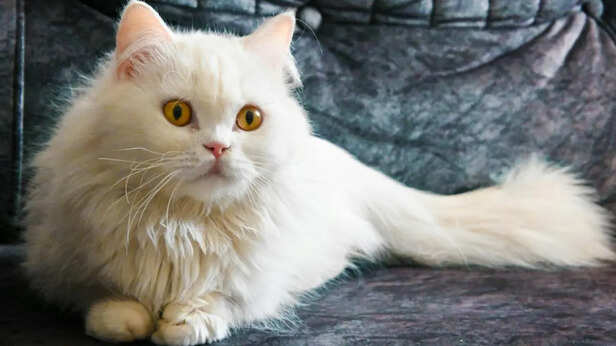
White Persian Cat on Sofa
Image credit : Pexels
From an evolutionary perspective, cats have always been opportunistic animals, meaning they naturally seek out food, shelter and safety, and living with humans provides all three, so it is true that your cat benefits from you in very practical ways, but science suggests that this does not cancel out emotional connection- it simply exists alongside it.
Interestingly, research has shown that domestic animals, including cats, can initiate and control interactions with humans based on their own preferences, meaning your cat may approach you not just because it needs something, but because it chooses to engage on its own terms.
The subtle ways cats show love
One of the biggest misunderstandings about cats is that they express affection very differently from humans and even from dogs, which is why their love is often overlooked or misinterpreted. When your cat rubs its head against you, follows you from room to room, slow-blinks while looking at you, or chooses to sit near you rather than somewhere else, these are not random behaviours but scientifically recognised signs of trust, comfort and social bonding, indicating that your cat sees you as part of its safe and familiar world.
Cats may not display affection constantly, but that is part of their nature, as they are both social and independent, meaning their interactions are often deliberate rather than continuous.
Why your cat seems “hot and cold”
If your cat sometimes acts loving and other times completely indifferent, it is not a sign of manipulation but rather a reflection of its natural behavioural patterns, because cats are known to value control over their environment and interactions, which means they prefer to initiate contact when they feel comfortable rather than respond on demand.
This behavior can make it seem like your cat only comes to you when it wants something, but in reality, it is choosing the timing of its affection, which is very different from not feeling it at all.
The truth science reveals
The idea that cats are purely self-serving animals is an oversimplification that doesn’t hold up under scientific scrutiny, because while they do rely on humans for resources, they are also capable of forming genuine emotional bonds, recognising their owners, responding to their voices and even showing signs of stress or attachment when separated.
The truth lies somewhere in between: your cat does benefit from you, but it also forms a relationship with you that includes trust, familiarity and a form of affection that may not look like human love- but is very real in its own way.
Love, just in a different language
In the end, your cat is neither using you nor loving you in the exact way you might expect- it is doing something more nuanced, forming a bond that blends instinct, dependency and genuine connection. And perhaps that is what makes it so special, because when a creature as independent as a cat chooses to trust you, seek you out and feel safe around you, it may not look like love in the traditional sense- but in the language of cats, it might just be the purest form of it.
Celebrate the bond with your pets, explore Health & Nutrition, discover Breeds, master Training Tips, Behavior Decoder, and set out on exciting Travel Tails with Times Pets!