The stare starts before the fork reaches your mouth. Your dog has already positioned itself. Your cat has appeared from nowhere and is watching with an intensity it rarely gives anything else. Most owners read it as begging, and leave it there. There is more happening.
They have learned that food comes from you
Dogs and cats both live in environments where humans control every meal. Over time, they build a clear association: the human eating is the event that most reliably precedes food becoming available. The stare is not an emotion. It is a conditioned response, the same learning mechanism that makes a dog sit when it hears a specific word. Watching you eat is the behaviour that has, at some point, paid off. Even if you only gave in once, that single reward can sustain the behaviour for months. This is intermittent reinforcement, and it is one of the most durable learning patterns in any mammal.
![Morning Meal Placement]()
Morning Meal Placement
Image credit : AI
I place the food bowl, mindful of the subtle grain and shallow depth of field. This scene evokes the quiet moments before a pet's meal, perhaps related to why pets stare when you eat.
They are reading your body and your food at the same time
Dogs in particular have an extraordinary ability to track human gaze, posture, and micro-expressions. Research into dog cognition has established that domestic dogs follow human pointing gestures and eye direction better than wolves raised alongside humans, which suggests this sensitivity evolved specifically through life with people. When your dog stares at you during a meal, it is monitoring your face for any shift that might signal food is coming its way. It is also using its nose. A dog's olfactory system processes smell at a level of detail that is difficult to overstate. From across a room, your meal is a layered set of signals, and some of what is on your plate smells, to your dog, like the best thing in the building.
For cats, the calculation is slightly different
Cats are less socially motivated by human approval than dogs, but they are no less strategic. A cat that stares at you while you eat has usually learned that proximity and eye contact during this specific window produce results. Cats are also predators whose attention is drawn by movement and smell. A plate of warm fish or chicken is an olfactory event. The stare is partly attention-seeking and partly genuine arousal around food. Unlike dogs, cats rarely sustain the behaviour out of social bonding. If a cat is watching you eat, it almost certainly expects something to happen.
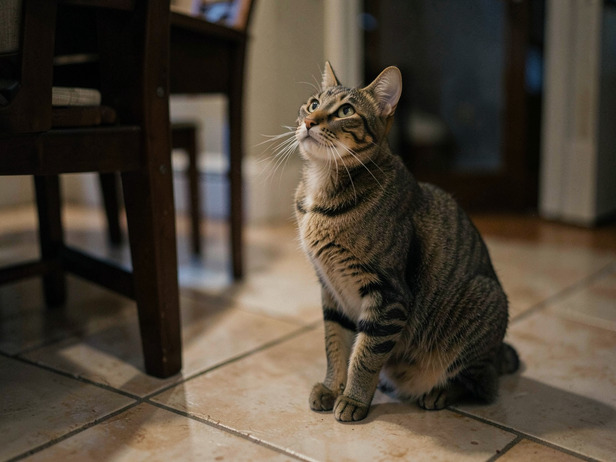
![Cat's Evening Gaze]()
Cat's Evening Gaze
Image credit : AI
I watch, hoping for a treat. This cat begging behaviour is so familiar.
What you have trained without meaning to
The stare is almost always a trained behaviour, even when the owner is certain they have never fed the pet from the table. Accidental reinforcement is common: a piece of food dropped and not retrieved, a bowl filled slightly earlier than usual because the stare felt uncomfortable, a bite offered once during a relaxed evening. Each of these teaches the animal that the stare is a working strategy. The behaviour strengthens when the reward is unpredictable, because unpredictability is what makes any behaviour hard to extinguish. The owner who gives in one time in ten is, from a learning-theory standpoint, the most effective trainer of persistent staring.
When the stare is about something other than food
Not every mealtime stare is food-driven. Dogs that are anxious about being separated from their owner may position themselves close during meals as a proximity behaviour, not a food-seeking one. A dog recovering from illness or one that has lost weight may show more intense food focus than usual, and a sudden increase in food-seeking behaviour in an animal that was previously relaxed about mealtimes is worth a vet check. Changes in appetite, weight, or the intensity of food-related behaviours can sometimes reflect thyroid changes, digestive issues, or other medical causes rather than habit.