Walk past a parrot's cage at the right moment and you'll find it hanging from the bars, head pointing at the floor, apparently unconcerned. First-time owners often freeze. The bird looks stuck, or sick, or doing something birds simply shouldn't do. It is doing something birds do constantly in the wild, and the fact that it's doing it in your living room is mostly good news.
It starts with how parrots actually eat
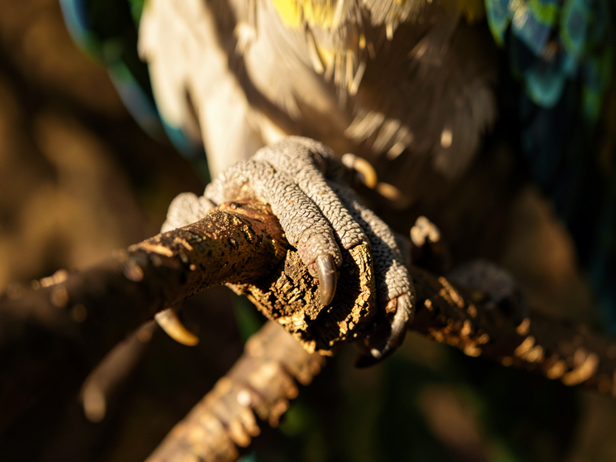
Parrots in the wild spend a large part of their day moving through tree canopies, reaching for fruit, seeds, and nuts at angles that would be impossible without flexible feet and a willingness to hang. Their zygodactyl feet, two toes pointing forward, two pointing back, give them a grip that works in any orientation. Hanging upside down to reach a piece of food wedged in bark or at the end of a branch is not a trick. It is the standard operating posture for foraging. A parrot in a cage that hangs to reach a treat clipped to the bars is doing exactly what its feet and instincts were built for.
![Parrot Foot Grips Branch]()
Parrot Foot Grips Branch
Image credit : AI
I observe the powerful grip of a parrot's foot, showcasing its unique zygodactyl structure. This detail helps explain why parrots hang upside down.
Play, and what it tells you about the bird's state of mind
A parrot that hangs upside down for no apparent food-related reason is almost always playing. Parrots are cognitively complex birds, species like African Greys, Amazons, Conures, and Cockatiels need regular mental engagement to stay psychologically healthy. Hanging, swinging, and climbing in unusual orientations is self-generated enrichment. It is the bird making its environment more interesting when the environment isn't doing that on its own. A parrot that plays this way is typically well-rested, comfortable with its surroundings, and not anxious. It is one of the cleaner behavioural signals that a bird is settled in its home.
Showing off, and the role of an audience
Many parrots hang upside down specifically when a person enters the room. This is not coincidence. Parrots are social animals that read their flock, in a home, that means you, and they learn which behaviours get attention. If hanging upside down has previously produced a reaction, a laugh, a camera pointed at them, or a voice saying something animated, the bird has filed that away. It repeats the behaviour because it works as communication. This is operant learning in a feathered body, and it is worth recognising because it means the bird is engaged with you, not just performing randomly.
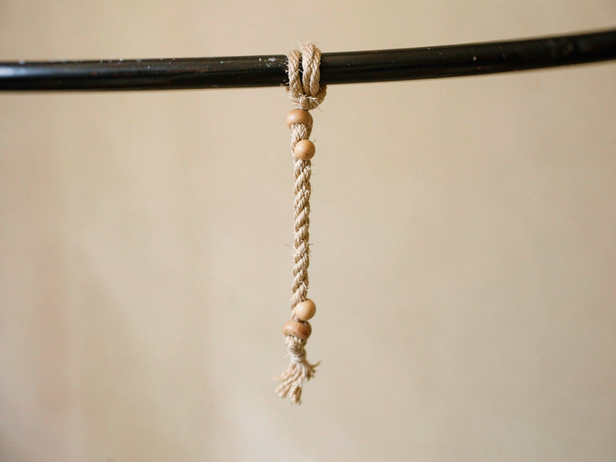
![Parrot Toy's Gentle Swing]()
Parrot Toy's Gentle Swing
Image credit : AI
This parrot toy's gentle swing might remind you of why parrots hang upside down. A simple, natural scene.
Stretching and physical comfort
Hanging inverted stretches the muscles along a parrot's back, shoulders, and wings in ways that perching upright does not. After a long rest, some parrots hang briefly the way a person might reach their arms overhead after sitting at a desk. It is a postural reset. This version tends to be short, a few seconds, and the bird returns to a normal perch without drama. It is easy to distinguish from sustained play-hanging, which lasts longer and often involves vocalisation or movement along the bars.
When upside-down hanging is worth watching
Hanging itself is not a symptom. The context around it can be. A parrot that hangs and cannot right itself, grips weakly, or falls is showing a physical problem, not a behavioural one. Weakness in the feet and legs can indicate nutritional deficiency, a neurological issue, or an internal condition that has nothing to do with the hanging itself. Similarly, a bird that hangs in a hunched posture, fluffs its feathers while doing so, or seems to be resting rather than playing may be using the position to manage discomfort rather than express contentment. Any hanging accompanied by laboured breathing, discharge, or a sudden change from the bird's normal behaviour is a reason to call a vet, not a reason to wait and see. The behaviour on its own is benign. The behaviour as a new development in a bird that previously didn't do it, or in a bird that also seems quieter or less interested in food, deserves attention from someone who can examine the animal properly.
Parrots hang upside down because their bodies are designed for it and because, in a cage that stays the same every day, it is one of the few ways they can make their world feel different. The bird is not confused about which way is up. It knows exactly what it's doing.