Cats that follow their owners to the bathroom are not malfunctioning. The behaviour is common enough that most cat owners have experienced it, and it has a set of overlapping explanations rooted in how cats read territory, time, and social bonds.
The bathroom is interesting territory
Cats map their home in fine detail. Running water, unfamiliar smells from soaps and shampoos, cool tile, the hum of an extractor fan, a bathroom is a sensory room that changes every time someone uses it. Cats are drawn to novelty in familiar spaces. A room that smells different from the rest of the flat, has a dripping tap, and contains a human sitting still is, from a cat's point of view, worth investigating. This is not affection; it is the same drive that makes a cat sit in a box or inspect a shopping bag the moment it lands on the floor.
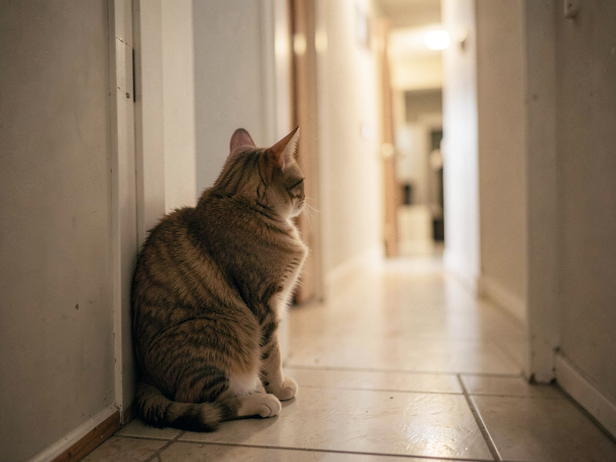
![Curious Cat at the Door]()
Curious Cat at the Door
Image credit : AI
I'm just checking if you need anything in there. Understanding cat social behaviour is fascinating.
You are briefly captive, and cats know it
A cat that wants attention has learned, through repetition, that a human in the bathroom is a human who is not going anywhere for a few minutes. Cats are observational learners. If following you to the bathroom has ever resulted in being stroked, spoken to, or simply being in the same room as you while you are still, the cat has logged that. The behaviour gets reinforced without the owner meaning to reinforce it. This is a basic operant conditioning loop: the cat offers a behaviour, a reward follows, the behaviour continues.
Territorial supervision and the closed-door effect
Many cats that ignore their owners for hours will become intensely interested in a closed door. Closing a door inside the cat's territory is, to the cat, an anomaly. Territory matters to cats not because they are possessive in a human sense, but because they rely on knowing what is in their space. A closed door means a part of the territory is inaccessible, and that registers as a problem worth solving. Some cats will scratch, meow, or wait. Others learn that following quickly enough means the door stays open. The bathroom is one of the few rooms in a flat where a door is routinely closed on a cat that was previously allowed in.
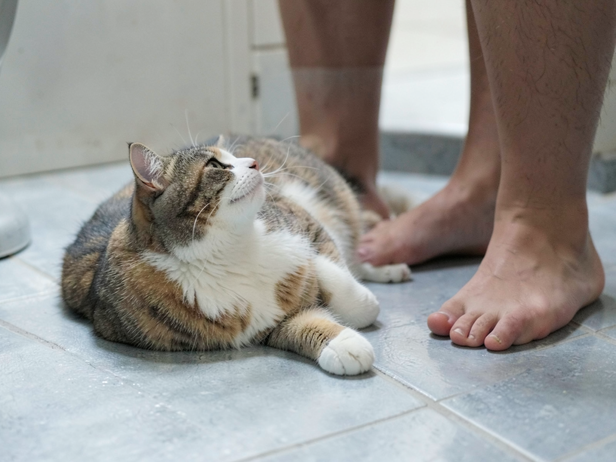
![Cat's Morning Ritual]()
Cat's Morning Ritual
Image credit : AI
My cat's morning ritual, a quiet presence as I get ready. Understanding why cats follow you to the bathroom is part of our bond.
Attachment and social following
Cats are often described as solitary, but domestic cats, particularly those raised with consistent human contact, form genuine social bonds. A cat that follows its owner from room to room, including to the bathroom, is often displaying what behaviourists call proximity-seeking. It wants to be near the person it is attached to. This is different from dependence; a well-adjusted cat will follow, settle nearby, and then go about its own business. The bathroom version of this is simply the tail end of a following pattern that started at the front door or the kitchen. The cat is not anxious. It is doing what socially bonded cats do, which is track the person they have chosen.
When the behaviour is worth paying attention to
Following you to the bathroom is, on its own, not a concern. The behaviour becomes worth a vet visit when it shifts in character: a cat that has never been clingy suddenly becomes unable to be alone, a cat that previously followed calmly now vocalises constantly, or following is paired with other changes like reduced appetite, increased thirst, or disrupted sleep. Sudden changes in social behaviour in cats can reflect pain, hyperthyroidism, cognitive decline in older cats, or anxiety with a medical root. The behaviour itself is normal; a sharp change in its intensity or quality is the signal.
The bathroom habit is one of the cleaner windows into how a cat actually thinks about its home and the people in it. Territory, conditioning, attachment, and curiosity are all running at once, and which one is driving the behaviour on a given day depends on the cat and the moment. Most of the time, the honest answer is that the cat finds you more interesting than the alternative.